DEF 14A: Definitive proxy statements
Published on April 30, 2026
UNITED STATES
SECURITIES AND EXCHANGE COMMISSION
Washington, D.C. 20549
SCHEDULE 14A
Proxy Statement Pursuant to Section 14(a) of
the Securities Exchange Act of 1934 (Amendment No. )
Filed by the Registrant☒
Filed by a Party other than the Registrant☐
Check the appropriate box:
☐ | Preliminary Proxy Statement |
☐ | Confidential, for Use of the Commission Only (as permitted by Rule 14a-6(e)(2)) |
☒ | Definitive Proxy Statement |
☐ | Definitive Additional Materials |
☐ | Soliciting Material under §240.14a-12 |
(Name of Registrant as Specified in its Charter)
(Name of Person(s) Filing Proxy Statement, if Other Than the Registrant)
Payment of Filing Fee (Check all boxes that apply):
☒ | No fee required. |
☐ | Fee paid previously with preliminary materials. |
☐ | Fee computed on table in exhibit required by Item 25(b) per Exchange Act Rules 14a-6(i)(1) and 0-11. |
CLEAN ENERGY FUELS CORP.
4675 MacArthur Court, Suite 800
Newport Beach, California 92660
April 30, 2026
Dear Stockholder,
You are cordially invited to attend the annual meeting of stockholders (“Annual Meeting”) of Clean Energy Fuels Corp. (the “Company,” “Clean Energy,” “we,” “us” or “our”) on Wednesday, June 10, 2026, at 9:00 a.m. Pacific Time. The Annual Meeting will be a virtual meeting conducted via live audio webcast that can be accessed by visiting www.virtualshareholdermeeting.com/CLNE2026. At this website, you will be able to listen to the Annual Meeting live, submit questions for our management, directors and representatives of our independent registered public accounting firm in attendance, and submit your vote while the Annual Meeting is being held.
I’m honored to be writing to you for the first time as Clean Energy’s chief executive officer. But I’m no stranger having been with the company for close to two decades. My goal as the incoming CEO is to focus on growing the company, using new technologies to find new customers and markets, engage with those customers, drive efficiencies and leverage the investments we’ve already made.
As we look back on 2025, it is clear that Clean Energy’s strategy and long-term investments continue to position us at the center of one of the most compelling transitions happening in transportation today. The momentum we’ve built across our renewable natural gas (“RNG”) production projects, fueling network, and customer base advanced significantly, and we closed 2025 stronger, more resilient, and more prepared for the growth ahead.
We now have eight dairy RNG projects in operation, along with three more in construction and development, each adding meaningful long term value to our RNG production portfolio. The completion of our South Fork Dairy project in Texas in 2025, now one of the largest RNG facilities in the country, was a huge milestone we crossed. South Fork is capable of producing 2.6 million gallons of low carbon-intensity transportation fuel annually, helping us continue to supply our network of stations and fleet customers.
The year also marked the successful monetization of $29.5 million in investment tax credits (“ITC”), the third ITC transaction tied to our RNG projects as part of our joint venture with bp. With this sale, all ITC credits across all six dairy RNG facilities have now been fully realized, reinforcing the value of these projects and strengthening the cash flow profile of our portfolio.
While our own RNG facilities continue to play an important role in supplying our network, they make up a portion of the fuel delivered across our stations. On the fuel supply side, we delivered 237 million gallons of RNG in 2025. To continue to support growing fleet demand, we draw from a broad, nationwide pool of producers, giving us access to diverse and reliable volumes of RNG from dairy, swine and landfill origins.
Our expansive fueling footprint remains an attractive outlet for RNG producers, as transportation use generates the strongest value for the fuel. As we grow, we remain disciplined in balancing the benefits of developing new projects with the flexibility that also comes from procuring RNG.
On the heavy duty trucking side of things, no segment of the transportation market is undergoing more rapid change, and 2025 was a milestone year on this front. The introduction of the Cummins X15N engine continued to energize the market.
Building on the success of our initial demonstration truck program from the year prior, we launched a second program featuring the Freightliner Cascadia tractor equipped with the X15N. Interest from fleets was strong, feedback and reviews are positive with many praising their firsthand experiences running heavy loads powered by RNG, while they continue to evaluate long-term alternatives to diesel. The combination of X15N performance and RNG’s carbon and cost advantages is resonating with major carriers nationwide.
We are also seeing rising demand across our transit and refuse customer base, who continue to adopt RNG not only as a means to decarbonize, but because it aligns with both budget and operational needs. In 2025, we secured more than a dozen new RNG supply agreements, adding over 10 million gallons of annual demand, while contracting 16 new stations and renewing long‑term supply at 17 existing locations. Combined, these commitments represent more than 30 million gallons of yearly fuel consumption and highlight the strength and staying power of our transit and refuse business.
As we look ahead, the opportunity in front of us is substantial. More fleets are acting now rather than waiting for alternative technologies that remain years from commercial viability. This aligns squarely with Clean Energy’s strategy: continue expanding our RNG supply, grow our customer base, and optimize the nation’s most extensive RNG fueling network. We are a unique company in that we provide a product to customers and to their customers that does good for the world. As I write this, traditional energy markets are being rocked by global events. But RNG is a domestic fuel that is not impacted by that. It also reduces harmful emissions, which we all care about.
Our development pipeline is active, our operational base is stronger than ever, and our ability to supply meaningful volumes of RNG, both produced and procured, is unmatched. With each new project, each new fleet deployment, and each gallon of RNG delivered, we strengthen our leadership position in the clean transportation market.
We are pleased to take advantage of laws and rules that allow issuers to make use of the Internet in conducting a meeting of stockholders, as well as in furnishing proxy materials. As a result, we will not only host the Annual Meeting virtually on the Internet, but we will also furnish the proxy materials for the Annual Meeting to our stockholders on the Internet. We believe this use of the Internet meaningfully lowers our costs, increases efficiencies and helps reduce the environmental impact of the Annual Meeting, while permitting and encouraging increased stockholder attendance and engagement.
The accompanying notice of Annual Meeting and Proxy Statement include the agenda for the Annual Meeting, explain the matters that will be discussed and voted on at the Annual Meeting and provide certain other information about our Company.
Your vote is important, and we urge you to vote as promptly as possible. Thank you for supporting our Company.
| Sincerely, |
| |
|
|
| |
| BARCLAY F. CORBUS |
| President & Chief Executive Officer |

CLEAN ENERGY FUELS CORP.
4675 MacArthur Court, Suite 800
Newport Beach, California 92660
NOTICE OF ANNUAL MEETING OF STOCKHOLDERS
June 10, 2026
The annual meeting of stockholders (“Annual Meeting”) of Clean Energy Fuels Corp. (the “Company,” “we,” “us” or “our”) will be held on Wednesday, June 10, 2026, at 9:00 a.m. Pacific Time via live audio webcast that can be accessed by visiting www.virtualshareholdermeeting.com/CLNE2026, for the following purposes:
| 1. | To elect six directors to our Board of Directors; |
| 2. | To ratify the appointment of KPMG LLP as our independent registered public accounting firm for our fiscal year ending December 31, 2026; |
| 3. | To approve, on an advisory, non-binding basis, the compensation of our named executive officers; and |
| 4. | To transact any other business that may properly come before the Annual Meeting or any adjournment or postponement of the Annual Meeting. |
The foregoing items of business are more fully described in the Proxy Statement that accompanies this notice.
The Company’s Board of Directors has fixed the close of business on April 16, 2026 as the record date for the determination of stockholders entitled to notice of and to vote at the Annual Meeting and any adjournment or postponement thereof. A list of stockholders entitled to vote at the Annual Meeting will be available for inspection by any stockholder for any purpose germane to the Annual Meeting at our principal executive offices during normal business hours for a period of 10 days before the Annual Meeting. The list of stockholders may also be accessed during the virtual Annual Meeting at www.virtualshareholdermeeting.com/CLNE2026 by using the control number on your proxy card, voting instruction form or Notice of Internet Availability.
Even if you plan to attend the Annual Meeting, you are encouraged to vote on the Internet, by telephone or by mail before the Annual Meeting using the instructions provided in the accompanying proxy materials to ensure that your vote will be counted. If you submit your proxy or voting instructions and then decide to attend the Annual Meeting, you may still vote your shares during the Annual Meeting.
| |
| By order of the Board of Directors, |
| |
|
|
| |
Dated: April 30, 2026 | JAMES W. SYTSMA |
| Corporate Secretary |
CLEAN ENERGY FUELS CORP.
4675 MacArthur Court, Suite 800
Newport Beach, California 92660
2026 PROXY STATEMENT
TABLE OF CONTENTS
| | | |
| | Page | |
| 1 | ||
SECURITY OWNERSHIP OF CERTAIN BENEFICIAL OWNERS AND MANAGEMENT | | 7 | |
| 9 | ||
RATIFICATION OF APPOINTMENT OF INDEPENDENT REGISTERED PUBLIC ACCOUNTING FIRM | | 14 | |
| 16 | ||
ADVISORY, NON-BINDING VOTE TO APPROVE EXECUTIVE COMPENSATION | | 17 | |
| 19 | ||
| 27 | ||
| 28 | ||
| 42 | ||
| 43 | ||
| 55 | ||
| 58 | ||
| 59 | ||
| 61 | ||
| | | |
i
CAUTIONARY NOTE REGARDING FORWARD-LOOKING STATEMENTS
This Proxy Statement includes forward-looking statements within the meaning of Section 27A of the Securities Act of 1933, as amended, and Section 21E of the Securities Exchange Act of 1934, as amended. Forward-looking statements are statements other than historical facts and relate to future events or circumstances or our future performance, and are based on our current assumptions, expectations and beliefs concerning future developments and their potential effect on our Company and our business. Forward-looking statements included herein include but are not limited to: statements about our Company’s position in the RNG market, our expectations regarding our dairy RNG projects and anticipated RNG facilities, the benefits of the Cummins X15N engine, and statements about our leadership transition and our position as a leading renewable energy company. Actual results, performance or achievements and the timing of events could differ materially from those anticipated in or implied by these forward-looking statements as a result of many factors, including, among others: the willingness of fleets and other consumers to adopt natural gas as a vehicle fuel, and the rate and level of any such adoption; the market’s perception of the benefits of RNG and conventional natural gas relative to other alternative vehicle fuels; natural gas vehicle and engine cost, fuel usage, availability, quality, safety, convenience, design, performance and residual value, as well as operator perception with respect to these factors, in general and in our key customer markets, including heavy-duty trucking; our ability to further develop and manage our RNG business, including our ability to procure adequate supplies of RNG and generate revenues from sales of such RNG; our and our suppliers’ ability to successfully develop and operate projects and produce expected volumes of RNG; the impact of a bankruptcy or failure of any source owners at our projects; our dependence on the production of vehicles and engines by manufacturers over which the we have no control; the long and variable development cycle required to secure anaerobic digester gas (“ADG”) RNG from new projects; the potential commercial viability, solvency, financial capacity, and operational capability of livestock waste and dairy farm projects to produce RNG; our history of net losses and the possibility that we could incur additional net losses in the future; our and our partners’ ability to acquire, finance, construct and develop other commercial projects; our ability to invest in hydrogen stations or modify our fueling stations to reform our RNG to fuel hydrogen and charge electric vehicles; the future supply, demand, use and prices of crude oil, gasoline, diesel, natural gas, and other vehicle fuels, including overall levels of and volatility in these factors; changes in the competitive environment in which we operate, including potentially increasing competition in the market for vehicle fuels generally; our ability to manage and increase our business of transporting and selling CNG (as defined below) for non-vehicle purposes via virtual natural gas pipelines and interconnects, as well as our station design and construction activities; construction, permitting and other factors that could cause delays or other problems at station construction projects; our ability to procure and maintain contracts with government entities; our ability to execute and realize the intended benefits of any acquisitions, divestitures, investments or other strategic relationships or transactions; significant fluctuations in our results of operations, which make it difficult to predict future results of operations; our warranty reserves may not adequately cover our warranty obligations; a future pandemic, epidemic or other infectious disease outbreak; the future availability of and our access to additional capital, which may include debt or equity financing, in the amounts and at the times needed to fund growth in our business and the repayment of our debt obligations (whether at or before their due dates) or other expenditures, as well as the terms and other effects of any such capital raising transaction; our ability to generate sufficient cash flows to repay our debt obligations as they come due; the availability of environmental, tax and other government legislation, regulations, programs and incentives that promote natural gas, including long-standing support for gasoline- and diesel-powered vehicles and growing support for electric and hydrogen-powered vehicles that could result in programs or incentives that favor these or other vehicles or vehicle fuels over natural gas; our ability to comply with various registration and regulatory requirements related to its RNG projects; the effect of, or potential for changes to greenhouse gas emissions requirements or other environmental regulations applicable to vehicles powered by gasoline, diesel, natural gas or other vehicle fuels and crude oil and natural gas fueling, drilling, production, transportation or use; our ability to manage the health, safety and environmental risks inherent in its operations; our compliance with all applicable government and environmental regulations; the impact of the foregoing on the trading price of our common stock; the interests of our significant stockholders may differ from our other stockholders; our ability to protect against any material failure, inadequacy, interruption or security failure of our information technology; general political, regulatory, economic and market conditions; and the other risks and uncertainties set forth under Item 1A, Risk Factors in our Annual Report on Form 10-K for the year ended December 31, 2025 that we filed with the Securities and Exchange Commission (“SEC”) and that accompanies this Proxy Statement, as such risk factors may be amended, supplemented or superseded from time to time by other reports we file with the SEC. We encourage you to carefully consider these risks and uncertainties. The forward-looking statements made in this Proxy Statement speak only as of the date of this Proxy Statement and we undertake no obligation to update publicly such forward-looking statements to reflect subsequent events or circumstances, except as otherwise required by law.
ii
WEBSITE REFERENCES
Throughout this Proxy Statement, we make references to additional information available on our corporate website at www.cleanenergyfuels.com. References to our website are provided for convenience only and the content on our website does not constitute a part of this Proxy Statement.
iii
CLEAN ENERGY FUELS CORP.
4675 MacArthur Court, Suite 800
Newport Beach, California 92660
2026 PROXY STATEMENT
GENERAL INFORMATION
The board of directors (“Board”) of Clean Energy Fuels Corp., a Delaware corporation (the “Company,” “we,” “us” or “our”), is providing this Proxy Statement (“Proxy Statement”) and all other proxy materials to you in connection with the solicitation of proxies for use at our 2026 annual meeting of stockholders (“Annual Meeting”). The Annual Meeting will be held on Wednesday, June 10, 2026, at 9:00 a.m. Pacific Time (“PT”) via live audio webcast that can be accessed by visiting www.virtualshareholdermeeting.com/CLNE2026 for the purposes stated in this Proxy Statement. In addition to any other business that may properly come before the Annual Meeting or any adjournment or postponement thereof, stockholders are being asked to vote at the Annual Meeting on the following three proposals:
Proposal 1. | The election of six directors to our Board. |
Proposal 2. | The ratification of the appointment of KPMG LLP as our independent registered public accounting firm for our fiscal year ending December 31, 2026. |
Proposal 3. | The approval, on an advisory, non-binding basis, of the compensation of our named executive officers, as disclosed in this Proxy Statement in accordance with the compensation disclosure rules of the Securities and Exchange Commission (“SEC”). |
This Proxy Statement summarizes the information you need to know in order to vote on these proposals in an informed manner.
IMPORTANT NOTICE REGARDING THE AVAILABILITY OF PROXY MATERIALS
The Notice of Annual Meeting, Proxy Statement and our 2025 Annual Report on Form 10-K (“Annual Report”) are available at www.proxyvote.com. You are encouraged to access and review all of the important information contained in our proxy materials before voting. Copies of these proxy materials are also available in the Investors — SEC Filings section of our website at https://investors.cleanenergyfuels.com/sec-filings/all-sec-filings.
Use of the Internet
Pursuant to rules adopted by the SEC, we have elected to provide access to our proxy materials for the Annual Meeting, including this Proxy Statement and our Annual Report, on the Internet. Accordingly, on or about April 30, 2026, we are mailing a Notice of Internet Availability of Proxy Materials (“Notice”) to all of our stockholders of record who have not previously elected an alternative delivery method, while brokers, banks and other nominees who hold shares on behalf of beneficial owners will be sending their own similar Notice to beneficial owners. The Notice will include instructions on how you may access the proxy materials for the Annual Meeting at www.proxyvote.com. For stockholders who have previously elected to receive copies of the proxy materials by mail or e-mail, we will be sending the Annual Report, this Proxy Statement and a proxy card by that method on or about April 30, 2026. Stockholders who receive a Notice will not receive printed copies of the proxy materials for the Annual Meeting unless they request them, in which case printed copies of the proxy materials and a paper proxy card will be provided at no charge. Instructions on how to request a printed copy of the proxy materials by mail or electronically, including an option to request paper copies on an ongoing basis, may be found in the Notice and on the website referred to in the Notice. We encourage you to take advantage
1
of the availability of our proxy materials on the Internet in order to lower our printing and delivery costs and help reduce the environmental impact of the Annual Meeting.
Virtual Annual Meeting
We will be holding the Annual Meeting virtually on the Internet via live audio webcast. No physical meeting will be held. Stockholders who attend the Annual Meeting virtually will be able to listen to the meeting live and submit their vote while the Annual Meeting is being held, and will also be able to submit, either anonymously or identified by name, questions or comments for our management, directors and representatives of our independent registered public accounting firm in attendance at the meeting. This functionality provides our stockholders with opportunities for participation and engagement at the Annual Meeting that are comparable to those that would be available at an in-person meeting.
During the Annual Meeting, we will answer as many stockholder-submitted questions as time permits, other than questions that are irrelevant to the purpose of the Annual Meeting or our business or that contain inappropriate or derogatory references.
Stockholders who choose to attend the Annual Meeting will do so by accessing a live audio webcast of the Annual Meeting via the Internet at www.virtualshareholdermeeting.com/CLNE2026. Please see “Attending the Virtual Annual Meeting” below for more information.
Record Date and Outstanding Shares
All stockholders that owned shares of our common stock at the close of business on April 16, 2026 (the “Record Date”), the date fixed by our Board as the record date, are entitled to vote at the Annual Meeting.
On the Record Date, 220,224,634 shares of our common stock were outstanding.
Voting Matters
Voting Rights
Each share of our common stock entitles the owner of the share to one vote for each share of common stock held by such owner on all matters to be voted on at the Annual Meeting.
Quorum Requirement
We will have the required quorum to conduct the business of the Annual Meeting if holders as of the Record Date representing a majority of the outstanding shares of our common stock entitled to vote are present in person or represented by proxy at the Annual Meeting. Abstentions and broker non-votes (discussed under “Effect of Not Providing Voting Instructions; Broker Non-Votes” below) will be counted for purposes of determining the presence of a quorum at the Annual Meeting.
Effect of Not Providing Voting Instructions; Broker Non-Votes
Stockholders of Record. You are a “stockholder of record” if your shares are registered directly in your name with Computershare Trust Company, N.A., our transfer agent. If you were a stockholder of record at the close of business on the Record Date and you submit a valid proxy but do not provide voting instructions with respect to your shares, all shares represented by your proxy will be voted in accordance with the recommendation of our Board on each proposal to be presented at the Annual Meeting, as described in this Proxy Statement.
2
Beneficial Owners of Shares Held in Street Name. You are a “beneficial owner of shares held in street name” if your shares are not held of record in your name but are held by a broker, bank or other nominee on your behalf as the beneficial owner. Pursuant to applicable stock exchange rules, if your shares were held in street name through a brokerage account at the close of business on Record Date, you must provide voting instructions to your broker if you want your shares to be voted on the election of directors (Proposal 1) and on the approval, on an advisory, non-binding basis, of the compensation of our named executive officers (Proposal 3). These proposals constitute “non-routine” matters on which a broker is not entitled to vote shares held for a beneficial owner without receiving voting instructions from the beneficial owner. The ratification of the appointment of KPMG LLP as our independent registered public accounting firm (Proposal 2) is considered a “routine” matter for which your shares may be voted in the discretion of your broker if voting instructions have not been received. As a result, if you hold your shares in street name and you do not submit voting instructions to your broker, your broker may exercise its discretion to vote on Proposal 2 at the Annual Meeting but will not be permitted to vote on Proposal 1 or Proposal 3 at the Annual Meeting. If your broker does not exercise this discretion, your shares might not be voted. Consequently, we urge every stockholder to vote their shares. If your broker does exercise this discretion, your shares will be counted as present for determining the presence of a quorum at the Annual Meeting and will be voted on Proposal 2 in the manner directed by your broker, but your shares will constitute “broker non-votes” on each of the other items at the Annual Meeting. Moreover, if you are a beneficial owner of shares in street name and you properly submit a voting instruction form to your broker, bank or other nominee that is signed but unmarked with respect to your vote on Proposals 1, 2, or 3, applicable rules will generally permit your broker, bank or other nominee to vote your shares on these proposals in accordance with the recommendations of our Board as set forth in this Proxy Statement.
Voting Requirements
The election of directors (Proposal 1) will be determined by a plurality of the votes cast on the proposal at the Annual Meeting. This means that the six nominees who receive the highest number of affirmative votes will be elected as directors. Shares voted “Withhold” and broker non-votes are not counted as votes cast and will have no effect on the outcome of the election of directors.
The ratification of the appointment of KPMG LLP as our independent registered public accounting firm (Proposal 2) and the approval, on an advisory, non-binding basis, of the compensation of our named executive officers (Proposal 3), must each be approved by the affirmative vote of a majority of the votes cast on the proposal at the Annual Meeting. For purposes of determining the number of votes cast for Proposals 2 and 3, only shares voted “FOR” or “AGAINST” are counted. Abstentions and broker non-votes are not treated as votes cast and will not be counted in determining the outcome of Proposals 2 or 3.
The following is a summary of the voting requirements for each proposal to be voted on at the Annual Meeting:
Proposal | | Vote Required | | Routine vs. | | Effect of Abstentions and |
1: Election of Directors | | Plurality of Votes Cast | | Non-Routine | | No effect |
2: Ratification of Independent Registered Public Accounting Firm | | Majority of Votes Cast | | Routine | | Abstentions: No effect |
3: Advisory, Non-Binding Vote on Executive Compensation | | Majority of Votes Cast | | Non-Routine | | No effect |
3
Tabulation of Votes
The inspector of elections of the Annual Meeting will tabulate the votes of our stockholders at the Annual Meeting. All shares of our common stock represented by proxy at the Annual Meeting will be voted in accordance with the instructions given on the proxy, as long as the proxy is properly submitted and unrevoked and is received by the applicable deadline, all as described under “How to Cast or Revoke Your Vote” below. If the Annual Meeting is adjourned or postponed, properly submitted and unrevoked proxies will remain effective and will be voted at the adjourned or postponed Annual Meeting, and stockholders will retain the right to revoke any such proxy until it is actually voted at the adjourned or postponed Annual Meeting.
Voting Results
Preliminary results will be announced at the Annual Meeting. Final results will be reported in a Current Report on Form 8-K to be filed with the SEC within four business days after the Annual Meeting concludes. If the official results are not available at that time, we will provide preliminary voting results in such Form 8-K and will provide the final results in an amendment to the Form 8-K as soon as they become available.
How to Cast or Revoke Your Vote
Stockholders of Record
If you are a stockholder of record entitled to vote at the Annual Meeting, you may vote in any one of the following ways:
| ● | On the Internet. You may vote by proxy before the Annual Meeting starts by visiting www.proxyvote.com or by following the instructions in the Notice or proxy card you received. |
| ● | By Telephone. If you receive printed copies of the proxy materials for the Annual Meeting, you may vote by proxy by calling the toll-free number found on the proxy card delivered with these proxy materials. |
| ● | By Mail. If you receive printed copies of the proxy materials for the Annual Meeting, you may vote by proxy by completing the proxy card delivered with these proxy materials and mailing it in the envelope provided. |
| ● | During the Annual Meeting. You may vote during the Annual Meeting by attending the live audio webcast at www.virtualshareholdermeeting.com/CLNE2026 and by following the instructions at www.virtualshareholdermeeting.com/CLNE2026. |
Votes submitted by proxy on the Internet or by telephone must be received by 11:59 p.m. Eastern Time on Tuesday, June 9, 2026 to be counted. Votes submitted on the Internet during the Annual Meeting by stockholders attending the meeting and votes submitted by mail must be received no later than the close of voting at the Annual Meeting to be counted.
Once you have submitted your proxy on the Internet or by telephone or mail, you may revoke it at any time before it is voted at the Annual Meeting by taking any one of the following actions:
| ● | Later-Dated Vote. You may revoke a previously submitted proxy by submitting a later-dated vote on the Internet, by telephone or by mail, as applicable. |
| ● | Written Notice. You may revoke a previously submitted proxy by sending or otherwise delivering a written notice of revocation to the attention of our Corporate Secretary at the address of our principal executive offices. |
4
| ● | Voting During the Annual Meeting. If you attend the live audio webcast of the Annual Meeting at www.virtualshareholdermeeting.com/CLNE2026, you may vote your shares electronically at the Annual Meeting, which will revoke any previously submitted proxy. |
To be effective, any later-dated vote must be received by the applicable deadline for the voting method used, as described above, and any written notice of revocation must be received no later than the close of voting at the Annual Meeting. Only your latest-dated vote that is received by the deadline applicable to the voting method used will be counted.
Beneficial Owners of Shares Held in Street Name
If you are a beneficial owner of shares held in street name, you have the right to instruct your broker, bank or other nominee on how to vote your shares at the Annual Meeting. You should do so by following the instructions provided by your broker, bank or other nominee regarding how to vote your shares and how to revoke a previously submitted proxy. The availability of Internet, telephone or other methods to vote your shares by proxy, and the deadlines by which to vote your shares using each such voting method, will depend on the voting processes of the broker, bank or other nominee that holds your shares.
Attending the Virtual Annual Meeting
All stockholders that owned our common stock at the close of business on the Record Date, or their duly appointed proxies, may attend and participate in the Annual Meeting. Even if you plan to attend the Annual Meeting, you are encouraged to vote on the Internet, by telephone or by mail before the Annual Meeting, to ensure that your vote will be counted. Please see “How to Cast or Revoke Your Vote” above.
To attend and participate in the Annual Meeting, stockholders will need to access the live audio webcast of the meeting. To do so, stockholders of record will need to visit www.virtualshareholdermeeting.com/CLNE2026 and use their control number provided in the Notice or, if they received printed copies of the proxy materials, in the proxy card delivered with those proxy materials, to log in to this website, and beneficial owners of shares held in street name will need to follow the instructions provided by the broker, bank or other nominee that holds their shares. On the day of the Annual Meeting, stockholders may begin to log in to the virtual meeting beginning at 8:45 a.m. PT, and the meeting will begin promptly at 9:00 a.m. PT. We encourage stockholders to log in to this website and access the webcast before the Annual Meeting’s start time. Further instructions on how to attend, participate in and vote at the Annual Meeting are available at www.proxyvote.com. If you encounter any difficulties accessing or logging in to the Annual Meeting, including any difficulties with your control number or submitting questions, please call the technical support number displayed on the login page on the online virtual meeting platform.
Submitting your proxy before the Annual Meeting will not affect your right to vote at the Annual Meeting if you decide to attend; however, your attendance at the Annual Meeting after having submitted a valid proxy will not in and of itself constitute a revocation of your proxy. To revoke a previously submitted proxy by attending the Annual Meeting, you must submit an online vote during the webcast of the Annual Meeting reflecting your new vote.
Solicitation
This solicitation is made by our Board, and we will bear the entire cost of soliciting proxies, including the costs of preparing, printing, assembling and mailing the Notice, any printed copies of this Proxy Statement, the proxy card, the Annual Report, and any additional information that we may elect to furnish to stockholders. We will provide copies of solicitation materials to brokers, banks and other nominees holding in their names shares of our common stock that are beneficially owned by others for forwarding to the beneficial owners of those shares who have requested printed materials, and we may reimburse persons representing beneficial owners for their costs of forwarding solicitation materials to the beneficial owners. Solicitations will be made primarily through the Notice and the solicitation materials made available on the Internet or via e-mail or in print to those who request copies of our proxy materials, but may be supplemented by telephone, mail, e-mail or personal solicitation by our directors, executive officers or other employees. We will pay no additional compensation to these individuals for these activities. We have not engaged employees for the specific purpose of soliciting proxies.
5
Separate Copy of Annual Report or Other Proxy Materials
We have adopted a procedure called “householding,” which the SEC has approved. Under this procedure, we are delivering a single copy of this Proxy Statement and our Annual Report to multiple stockholders who share the same address and who did not receive a Notice or otherwise receive their proxy materials by e-mail, unless we have received contrary instructions from a stockholder. This procedure reduces our printing and mailing costs and other fees. Stockholders who participate in householding will continue to be able to request and receive a separate Notice or proxy card. Additionally, upon written or oral request, we will deliver promptly a separate copy of this Proxy Statement or the Annual Report to any stockholder at a shared address to which we have delivered a single copy of these documents. To receive a separate copy of this Proxy Statement or the Annual Report, or to notify us that you wish to receive separate copies of our proxy materials for future annual meetings of our stockholders, write to the attention of Investor Relations at our principal executive offices at 4675 MacArthur Court, Suite 800 Newport Beach, California 92660, or call (949) 437-1000. Stockholders who share an address and are receiving multiple copies of our proxy materials may also request to receive a single copy of this Proxy Statement and the Annual Report or our proxy materials for future annual meetings of our stockholders by writing or calling us at the address or telephone number provided above.
6
SECURITY OWNERSHIP OF CERTAIN BENEFICIAL OWNERS AND MANAGEMENT
The two tables below show the beneficial ownership of certain persons with respect to our common stock, our only outstanding class of voting securities. Except as indicated by the footnotes to these tables, we believe, based on the information furnished or otherwise available to us, that the persons and entities named in these tables have sole voting and investment power with respect to all shares of common stock shown as beneficially owned by them, subject to applicable community property laws.
We have determined beneficial ownership as shown in these tables in accordance with the rules of the SEC. In accordance with these rules, in computing the number of shares of our common stock beneficially owned by a person and the percentage ownership of that person, we deemed to be outstanding all shares of our common stock subject to (1) stock options held by that person that are currently exercisable or exercisable within 60 days after April 16, 2026, and (2) restricted stock units (“RSUs”) held by that person that are subject to vesting and settlement within 60 days after April 16, 2026. We did not, however, deem these shares outstanding for the purpose of computing the percentage ownership of any other person. We calculated percentage ownership as shown in these tables based on 220,224,634 shares of our common stock outstanding on April 16, 2026. The information in these tables is not necessarily indicative of beneficial ownership for any other purpose, and the inclusion of any shares in these tables does not constitute an admission of beneficial ownership of the shares.
The following table shows the amount and percentage of our common stock beneficially owned by each holder of more than 5% of the outstanding shares of our common stock:
| | | | | |
| | Common | | Percentage of |
|
| | Stock | | Common |
|
| | Beneficially | | Stock |
|
Name and Address of Beneficial Owner | | Owned | | Outstanding |
|
TotalEnergies S.E./ Total Marketing Services S.A.S.(1) |
| 51,039,970 |
| 23.18 | % |
2, place Jean Millier | | | | | |
La Défense 6 | | | | | |
92400 Courbevoie | | | | | |
France | | | | | |
Stonepeak CLNE-W Holdings LP(2) | | 20,050,618 | | 9.10 | % |
55 Hudson Yards | | | | | |
New York, New York 10001 | | | | | |
550 W. 34th Street, 48th Floor | | | | | |
New York, New York 10001 | | | | | |
BlackRock, Inc.(3) |
| 14,715,639 |
| 6.68 | % |
50 Hudson Yards | | | | | |
New York, New York 10001 | | | | | |
Grantham, Mayo, Van Otterloo & Co. LLC(4) | | 13,228,248 | | 6.01 | % |
53 State Street, Suite 3300 | | | | | |
Boston, Massachusetts 02109 | | | | | |
(1) | Based on a Schedule 13D/A filed by TotalEnergies S.E. (“TotalEnergies”) and its direct wholly owned subsidiary Total Marketing Services S.A.S. (“TMS”) on February 27, 2026 that reflects shares of common stock beneficially owned as of February 27, 2026. TotalEnergies and TMS have (i) shared voting power over 51,039,970 shares of our common stock, which consists of (a) 42,581,801 shares of our common stock that were purchased by TMS pursuant to a stock purchase agreement, dated May 9, 2018, between TMS and our Company, and (b) 8,521,393 shares of common stock that are the subject of a voting agreement, dated May 9, 2018, among TMS, our Company, and all of our then-directors and officers, pursuant to which each such director and officer appointed TMS as such person’s proxy and attorney-in-fact, and authorized TMS to represent and vote (or consent, if applicable) all shares of common stock owned or controlled by such person with respect to the election of the individuals designated by TMS to serve on our Board pursuant to TMS’ director designation rights (described below under “Certain Relationships and Related Party Transactions”), and (ii) shared dispositive power over 42,581,801 shares of our common stock. TotalEnergies and TMS have expressly disclaimed beneficial ownership of any shares of common stock subject to the voting agreement discussed in (i)(b) above. |
(2) | Based on a Schedule 13G filed by Stonepeak CLNE-W Holdings LP, Stonepeak Opportunities Fund Associates LP, Stonepeak Opportunities Fund GP Investors LP, Stonepeak GP Investors Holdings LP, Stonepeak GP Investors Upper Holdings LP, Stonepeak GP Investors Holdings Manager LLC, and Michael B. Dorrell (together, the “Stonepeak Investors”) on October 15, 2025 that reflects shares of common stock beneficially owned |
7
as of October 13, 2025. According to the Schedule 13G, the Stonepeak Investors have shared voting power and shared dispositive power with respect to 20,050,618 shares of our common stock that were purchased by Stonepeak CLNE-W Holdings LP pursuant to a warrant agreement dated December 12, 2023, between Stonepeak CLNE-W Holdings LP and our Company, that became exercisable by Stonepeak CLNE-W Holdings LP on December 12, 2025.
(3) | Based on a Schedule 13G/A filed by BlackRock, Inc. on April 17, 2025 that reflects shares of common stock beneficially owned as of March 31, 2025. According to the Schedule 13G/A, BlackRock, Inc. has sole voting power with respect to 14,376,363 shares of our common stock and sole dispositive power with respect to 14,715,639 shares of our common stock. |
(4) | Based on a Schedule 13G/A filed by Grantham, Mayo, Van Otterloo & Co. LLC (“Grantham”) on May 1, 2025 that reflects shares of common stock beneficially owned as of March 31, 2025. According to the Schedule 13G/A, Grantham has sole voting power and sole dispositive power with respect to 13,228,248 shares of our common stock. |
The following table shows the amount and percentage of our common stock beneficially owned on April 16, 2026 by each of our named executive officers and current directors and by all of our current executive officers and current directors as a group:
| | | | | |
| | Common Stock |
| ||
| | Beneficially Owned |
| ||
Name of Beneficial Owner | | Number | | % |
|
Andrew J. Littlefair(1) |
| 3,252,970 |
| 1.48 | % |
Robert M. Vreeland(2) |
| 1,691,817 |
| * | |
Barclay F. Corbus(3) |
| 2,145,877 |
| * | |
Lizabeth A. Ardisana(4) |
| 388,203 |
| * | |
Patrick J. Ford(5) |
| 174,372 |
| * | |
Stephen A. Scully(6) |
| 683,008 |
| * | |
Vincent C. Taormina(7) |
| 747,721 |
| * | |
All current executive officers and current directors as a group (7 persons)(8) |
| 9,083,968 | | 4.12 | % |
* Represents less than 1%
| (1) | Beneficial ownership consists of (a) 1,576,232 shares of common stock subject to stock options currently exercisable or exercisable within 60 days after April 16, 2026, and (b) 1,676,738 shares of outstanding common stock held directly. |
| (2) | Beneficial ownership consists of (a) 859,543 shares of common stock subject to stock options currently exercisable or exercisable within 60 days after April 16, 2026, and (b) 832,274 shares of outstanding common stock held directly. |
| (3) | Beneficial ownership consists of (a) 976,388 shares of common stock subject to stock options currently exercisable or exercisable within 60 days after April 16, 2026, and (b) 1,169,489 shares of outstanding common stock held directly or by an individual retirement account for the benefit of Mr. Corbus. |
| (4) | Beneficial ownership consists of (a) 257,658 shares of common stock subject to stock options currently exercisable or exercisable within 60 days after April 16, 2026, (b) 32,258 shares of common stock subject to restricted stock units vesting within 60 days after April 16, and (c) 98,287 shares of outstanding common stock held directly. |
| (5) | Beneficial ownership consists of (a) 83,154 shares of common stock subject to stock options currently exercisable or exercisable within 60 days after April 16, 2026, (b) 32,258 shares of common stock subject to restricted stock units vesting within 60 days after April 16, 2026, and (c) 58,960 shares of outstanding common stock held directly. |
| (6) | Beneficial ownership consists of (a) 383,345 shares of common stock subject to stock options currently exercisable or exercisable within 60 days after April 16, 2026, (b) 32,258 shares of common stock subject to restricted stock units vesting within 60 days after April 16, 2026, and (c) 267,405 shares of outstanding common stock held by the Scully Family Trust, over which Mr. Scully possesses sole voting and investment control. |
| (7) | Beneficial ownership consists of (a) 360,158 shares of common stock subject to options currently exercisable or exercisable within 60 days after April 16, 2026, (b) 32,258 shares of common stock subject to restricted stock units vesting within 60 days after April 16, 2026, and (c) 355,305 shares of outstanding common stock held by the Vincent C. Taormina REV Intervivos Trust UAD 5/14/84, over which Mr. Taormina possesses sole voting and investment control. |
| (8) | Beneficial ownership consists of (a) 4,496,478 shares of common stock subject to stock options currently exercisable or exercisable within 60 days after April 16, 2026, (b) 129,032 shares of common stock subject to restricted stock units vesting within 60 days after April 16, 2026, and (c) 4,458,458 shares of outstanding common stock held directly by our current executive officers and directors, by individual retirement accounts for the benefit of a director or executive officer, or by trusts or a Uniform Transfers to Minors Act account over which an executive officer or director possesses voting and investment control. |
8
PROPOSAL 1
ELECTION OF DIRECTORS
General
Upon the recommendation of our nominating and corporate governance committee, our Board nominated our current directors Barclay F. Corbus, Andrew J. Littlefair, Stephen A. Scully, Lizabeth A. Ardisana, Patrick J. Ford, and Vincent C. Taormina, for election as members of our Board at the Annual Meeting. As disclosed in our Current Report on Form 8-K filed on April 23, 2026, on April 22, 2026 our Board, based on the recommendation of our nominating and corporate governance committee, appointed Mr. Corbus as a director in connection with our Company’s Chief Executive Officer Transition. Mr. Corbus will be standing for election to our Board for the first time at the Annual Meeting. Each of our director nominees, other than Messrs. Corbus and Littlefair, are independent directors within the meaning of applicable rules of The Nasdaq Stock Market LLC (“Nasdaq”). Each of the nominees is a current director of our Company and, other than Mr. Corbus, was elected by our stockholders at our 2025 annual meeting of stockholders.
Upon election at the Annual Meeting, each director will serve a one-year term until the next annual meeting of our stockholders and until his or her respective successor is duly elected and qualified or until his or her earlier resignation or removal. Each of our Board’s director nominees has agreed to serve if elected, and, as of the date of this Proxy Statement, we have no reason to believe any nominee will be unable or unwilling to serve as a director if elected. If, however, any nominee is unable to serve, or for good cause will not serve, as a director at the time of the Annual Meeting, the persons who are designated as proxies may vote your shares, in their discretion, for another nominee that may be proposed by our Board or our Board may choose to reduce the size of the Board.
We, as a matter of policy, encourage our directors to attend meetings of our stockholders and, in 2025, all of our then-current directors attended our annual meeting of stockholders.
Director Nominees
The names of the director nominees, their ages as of the date of this Proxy Statement, their current positions and offices with our Company and other information about their professional backgrounds are shown below. We believe each of these nominees contributes to our Board’s effectiveness as a whole based on the wealth of executive leadership experience they bring to our Board, as well as the other specific attributes, qualifications and skills described below. There are no family relationships between any director, executive officer or person nominated or chosen to become a director or executive officer of our Company, and there are no arrangements or understandings between any director or nominee and any other person pursuant to which such individual was or is selected as a director or nominee.
| | | | |
Name of Director Nominee | | Age | | Position(s) and Office(s) |
Barclay F. Corbus | | 59 | | President, Chief Executive Officer and Director |
Stephen A. Scully | | 67 | | Chairman of the Board |
Lizabeth A. Ardisana | | 75 | | Director |
Patrick J. Ford | | 64 | | Director |
Andrew J. Littlefair | | 65 | | Director |
Vincent C. Taormina | | 70 | | Director |
Barclay F. Corbus has served as our President, Chief Executive Officer and a director since April 22, 2026. Previously, Mr. Corbus served as our Senior Vice President, Strategic Development and Head of Renewable Fuels from December 2021 to April 22, 2026. Prior to that, Mr. Corbus served as our Senior Vice President, Strategic Development from September 2007 to December 2021. From July 2003 to September 2007, Mr. Corbus served as Co-Chief Executive Officer and a director of WR Hambrecht + Co, an investment bank that managed our initial public offering. Mr. Corbus joined WR Hambrecht + Co in 1999 and, from October 2000 to July 2003, Mr. Corbus served as Head of Investment Banking of WR Hambrecht + Co. From 1989 to 1999, Mr. Corbus worked with Donaldson, Lufkin & Jenrette. Mr. Corbus serves as a director of Bed Bath & Beyond, Inc., a publicly traded company, since March 2007 and is a Trustee of the College of the Atlantic. He has previously served on the boards of Alaska Energy and Resources Co, WR Hambrecht +
9
Co., Niman Ranch, and Goodwill of San Francisco. Mr. Corbus earned an B.A. in government from Dartmouth College and an M.B.A from Columbia Business School.
Skills and Qualifications: Mr. Corbus brings to our Board his nineteen years of experience at the Company in senior executive positions leading corporate strategy, M&A and financing activities, as well as our growing RNG production and distribution businesses, which gives him unique insight into our Company’s operations, challenges, and opportunities.
Stephen A. Scully has served as a director of our Company since January 2014 and was appointed Chairman of the Board effective January 1, 2018. Mr. Scully was the founder and President of The Scully Companies, a California-based full service truck leasing and specialized contract carriage provider. He founded The Scully Companies in 1981 after graduating from the University of Southern California and subsequently sold the business to Ryder System, Inc. in January 2011. The Scully Companies was the largest independent asset-based logistics provider in the western United States. Since selling The Scully Companies, Mr. Scully has been a private investor and has served on the Newport Beach Harbor Commission since 2009, including two terms as Chairman. Mr. Scully previously served as a board member and two terms as Chairman of the Board of National Truck Leasing System from 1999 to 2010, as a board member of the Truck Rental and Leasing Association from 1990 to 1999, and as a board member of Ameriquest Transportation and Logistics Resources from 2007 to 2008. He is a former member of the California Trucking Association.
Skills and Qualifications: Mr. Scully brings to our Board the perspective of a founder and operator, along with extensive experience in the trucking and logistics industry and public-company board leadership.
Lizabeth A. Ardisana has served as a director of our Company since December 2019. Ms. Ardisana is the Chief Executive Officer and the Principal Owner of the firm ASG Renaissance, LLC, which she founded in 1987. ASG Renaissance is a technical and communication services firm with experience providing services to clients in the automotive, environmental, defense, construction, healthcare, banking, and education sectors. Ms. Ardisana is also Chief Executive Officer of Performance Driven Workforce, LLC, a scheduling and staffing firm that was founded in 2015 and has since expanded into five states. Ms. Ardisana, a Hispanic and female business owner, is an active business and civic leader in Michigan. Ms. Ardisana has held numerous leadership positions in a variety of non-profit organizations, including CS Mott Foundation, Kettering University, Metropolitan Affairs Coalition and Focus: Hope. She was appointed by the governor of Michigan to the executive board of the Michigan Economic Development Corporation and serves on its finance committee. Ms. Ardisana is also vice chair of Wayne Health where she serves on the audit committee. On October 10, 2022, Ms. Ardisana was appointed to the Board of Directors of Hannon Armstrong Sustainable Infrastructure Capital, Inc., a leading investor in climate solutions. She previously served as a member of the board of directors of LeddarTech Holdings Inc., a publicly traded company, from January 2024 to June 2025, Huntington Bancshares Inc., a publicly traded company, from 2016 to 2023 and as a member of the board of directors of FirstMerit Corporation from 2013 to 2016. Ms. Ardisana previously served as a board member of United Way for Southeastern Michigan (where she served as chair) and the Skillman Foundation. Ms. Ardisana holds a bachelor’s degree in mathematics and computer science from the University of Texas, a master’s degree in Mechanical Engineering from the University of Michigan and a master’s degree in Business Administration from the University of Detroit.
Skills and Qualifications: Ms. Ardisana brings to our Board key experience and relationships in the automotive and environmental industries, as well as skills acquired through serving as a chief executive officer and as a member of multiple public and private company boards.
Patrick J. Ford has served as a director of our Company since March 2024. Mr. Ford served as an Audit Partner at KPMG LLP, an accounting and advisory firm, from 1994 until his retirement in 2022. Mr. Ford served numerous SEC registrants as the Lead Audit Engagement Partner in the energy, automotive and technology sectors during his tenure with KPMG LLP. Mr. Ford served as a member of the Board of Directors of KPMG LLP and its related entity, KPMG Americas LLP from 2013 to 2018. Mr. Ford is a certified public accountant (retired status) in California. Since 2025, Mr. Ford has served on The Board of Directors of Claremont Lincoln University and previously served on the Board of Advisors for the University of Southern California Marshall School of Business from 2006 to 2019 and the Board of Advisors for the Shidler School of Business at the University of Hawaii at Manoa from 2003 to 2007. Mr. Ford holds a bachelor’s degree in business administration with an emphasis in accounting from the University of Southern California.
10
Skills and Qualifications: Mr. Ford brings to our Board extensive experience in finance and accounting within the energy industry.
Andrew J. Littlefair, one of our founders, has served as a director since June 2001. Previously, Mr. Littlefair served as our President and Chief Executive Officer from June 2001 to April 22, 2026. From 1996 to 2001, Mr. Littlefair served as President of Pickens Fuel Corp., and from 1987 to 1996, Mr. Littlefair served in various management positions at Mesa, Inc., an energy company. From 1983 to 1987, Mr. Littlefair served in the Reagan Administration as a Staff Assistant to the President. Mr. Littlefair served as the chairman of the board of directors of SAFE S.p.A. and also served on the board of directors of Hilltop Holdings Inc. (formerly PlainsCapital Corporation), a reporting company under the Securities Exchange Act of 1934, as amended (“Exchange Act”), from 2009 to 2023. Mr. Littlefair served as Chairman of NGV America, the leading U.S. advocacy group for natural gas vehicles, from March 2003 to March 2011. He has served on the Ronald Reagan Presidential Foundation & Institute Board of Trustees since July 2011. Mr. Littlefair earned a B.A. from the University of Southern California.
Skills and Qualifications: Mr. Littlefair brings to our Board his experience as a co-founder and as the former President and Chief Executive Officer of our Company, which gives him unique insight into our Company’s operations, challenges and opportunities.
Vincent C. Taormina has served as a director of our Company since April 2008. Mr. Taormina is the former Chief Executive Officer of Taormina Industries, Inc., one of California’s largest solid waste and recycling companies. In 1997, Taormina Industries, Inc. merged with Republic Services, a publicly-held waste handling company that operates throughout the United States. Mr. Taormina served as Regional Vice President of Republic Services from 1997 to 2001, managing the overall operations of eleven western states. Since 2001, Mr. Taormina has served and continues to serve as a consultant to Republic Services and is a private investor. Mr. Taormina is a past President of the Orange County Solid Waste Management Association, past President Elect of the California Refuse Removal Council and a former board member of the Waste Recyclers Council for the National Solid Waste Management Board.
Skills and Qualifications: Mr. Taormina brings to our Board the perspective of a highly successful entrepreneur and industry leader in the refuse and recycling industry.
Selecting Our Director Nominees
Under its charter and our corporate governance guidelines, our nominating and corporate governance committee is responsible for reviewing with our Board, on an annual basis, the requisite skills and characteristics of potential new Board members, as well as the composition of our Board as a whole. This assessment includes an analysis of each member’s qualifications as a director and each member’s independence, as well as consideration of age, experience and other factors in the context of the needs of our Board.
Director Criteria
Pursuant to our corporate governance guidelines, a majority of our directors must meet the standards for independence as required by Nasdaq, and no director may serve on more than three other public company boards of directors unless approved in advance by our Board. Further, applicable Nasdaq rules provide that at least one member of our Board must meet the criteria for an “audit committee financial expert” as defined by SEC rules, and the members of certain of our Board committees must satisfy enhanced independence and financial expertise standards under applicable Nasdaq and SEC rules. We also believe all directors should possess the following attributes:
| ● | Professional ethics and values, consistent with our code of ethics (described below under “Corporate Governance — Code of Ethics”); |
| ● | A commitment to building stockholder value; |
| ● | Business acumen and broad experience and expertise at the policy-making level in one or more of the areas of particular consideration described under “Key Qualifications, Skills and Attributes” below; |
11
| ● | The ability to provide insights and practical wisdom based on the individual’s experience or expertise; and |
| ● | Sufficient time to effectively carry out duties as a Board member. |
Other than the foregoing, there are no stated minimum criteria for director nominees, and our nominating and corporate governance committee may consider these factors and any such other factors as it deems appropriate. Our nominating and corporate governance committee does, however, review the activities and associations of each potential director candidate to ensure there is no legal impediment, conflict of interest or other consideration that might hinder or prevent service on our Board.
Although we do not have a formal policy with respect to Board diversity, our nominating and corporate governance committee strives to assemble a board of directors that brings to our Company a variety of perspectives, skills and expertise. To achieve this, our nominating and corporate governance committee considers individuals diversity in the broadest sense, including persons diverse in geography, gender, ethnicity, age, and experience, including business, professional, governmental, community involvement and natural gas and energy industry experience, in recommending director nominees to our Board.
Our nominating and corporate governance committee assesses these and other factors as it deems appropriate in connection with its annual review of each director and our Board as a whole and takes these factors into account when determining whether to nominate existing directors for re-election in connection with this annual review. Our nominating and corporate governance committee also takes these factors into account when considering any director nominee outside of its annual review process, such as when a vacancy exists on our Board or when a stockholder suggests a new director candidate that the committee or our Board decides to consider for appointment.
Board Refreshment
We aim to regularly bring new directors to our Board at a responsible pace to ensure our Board benefits from fresh ideas and perspectives, while balancing the importance of directors who have experience with our Company.
Board refreshment is a key matter considered during our annual Board and committee self-evaluations. The average tenure of our nominated Board members is eleven (11) years.
Key Qualifications, Skills and Attributes
Our nominating and corporate governance committee regularly reviews the appropriate skills and characteristics required of Board members in the context of the composition of our Board, our operating requirements, and the long-term interests of stockholders. When conducting its review of the key qualifications, skills and attributes desired of Board members, our nominating and corporate governance committee particularly considers:
Senior Leadership Experience
Board members who have served in senior leadership positions, such as a chief executive officer, chairman, senior executive, or leader of significant operations, are important to us because they have the experience and perspective to analyze, shape and oversee the execution of important strategic, operational and policy issues. These Board members’ insights and guidance, and their ability to assess and respond to situations encountered by our Board, may be enhanced by leadership experience at complex businesses or organizations.
RNG and Conventional Natural Gas and Industry Experience
Because we are seeking to drive adoption of RNG and conventional natural gas as a vehicle fuel by fleet vehicle operators, primarily in the trucking, airport, refuse, public transit, industrial and institutional energy user and government fleet markets, relevant education or experience in our industry is key for understanding our markets, strategy, risk management and operations.
12
Government, Legal, Public Policy and Regulatory Experience
Board members who have served in government positions provide experience and insights that help us work constructively with governments and address significant public policy issues. Board members with a background in law can assist our Board and legal team in fulfilling its oversight responsibilities regarding our legal and regulatory compliance and our engagement with regulatory authorities.
Financial Expertise
Knowledge of financial markets, financing and funding operations and accounting and financial disclosure and reporting processes is important to have well-represented on our Board. This experience helps our Board members in understanding and overseeing our capital structure, financing and investing activities, as well as our financial reporting and internal controls.
Public and Private Company Board Experience
Board members with public and private company board experience understand the dynamics and operations of a corporate board. These matters include the relationship of a company board with senior management personnel, the legal and regulatory landscape in which companies must operate, the importance of particular agenda and oversight issues, and how to oversee an ever-changing mix of strategic, operational and compliance-related matters.
From time to time, our nominating and corporate governance committee will also consider such other qualifications, skills and attributes as it deems appropriate given the needs of our Board and our Company to maintain a balance of knowledge, experience, background and capability.
Director Nominee Evaluations
At least annually, our nominating and corporate governance committee leads an evaluation of each of our directors and our Board as a whole and each of its committees. In evaluating whether a current director should continue to serve on our Board, our nominating and corporate governance committee considers a number of factors, including those described above and each director’s qualifications, skills and attributes in the areas identified by our nominating and governance committee as particularly important to our Board. In concluding that each of the director nominees should continue to serve as directors of our Company, our nominating and corporate governance committee considered their knowledge, experience and expertise in these areas as indicated in the table below, which they gained from their professional backgrounds described under “Director Nominees” above.
| | | | | | | | | | |
| | | | RNG and | | Government, | | | | |
| | Senior | | Natural Gas | | Legal and | | | | Company |
| | Leadership | | Industry | | Regulatory | | Financial | | Board |
Director | | Experience | | Experience | | Expertise | | Expertise | | Experience |
Barclay F. Corbus | | √ |
| √ |
| √ |
| √ |
| √ |
Stephen A. Scully |
| √ |
| √ |
| |
| √ |
| √ |
Lizabeth A. Ardisana |
| √ |
| √ |
| √ |
| √ |
| √ |
Patrick J. Ford |
| √ |
| √ |
| √ |
| √ |
| √ |
Andrew J. Littlefair |
| √ |
| √ |
| √ |
| √ |
| √ |
Vincent C. Taormina |
| √ |
| √ |
| |
| |
| |
Vote Required for Approval of the Election of Directors
Directors are elected by a plurality of votes cast in the election of directors at the Annual Meeting. The six nominees who receive the highest number of affirmative votes will be elected as directors. Shares voted “Withhold” and broker non-votes are not counted as votes cast and will have no effect on the outcome of the election of directors.
OUR BOARD RECOMMENDS A VOTE “FOR ALL” THE DIRECTOR NOMINEES
NAMED IN THIS PROPOSAL 1
13
PROPOSAL 2
RATIFICATION OF APPOINTMENT OF INDEPENDENT REGISTERED
PUBLIC ACCOUNTING FIRM
General
We are asking our stockholders to ratify the appointment of KPMG LLP as our independent registered public accounting firm for our fiscal year ending December 31, 2026. KPMG LLP has audited our financial statements annually since 2001. Representatives of KPMG LLP are expected to be present at the Annual Meeting. They will have the opportunity to make a statement, if they desire to do so, and respond to appropriate questions from stockholders.
Although our amended and restated bylaws do not require that our stockholders approve the appointment of our independent registered public accounting firm, we are submitting the appointment of KPMG LLP to our stockholders for ratification as a matter of good corporate practice. If our stockholders vote against the ratification of the appointment of KPMG LLP, our audit committee may consider whether to retain the firm. Even if our stockholders ratify the appointment of KPMG LLP, our audit committee may choose to appoint a different independent registered public accounting firm at any time during the year if the committee determines that such a change would, in its judgment, be in the best interests of our Company and our stockholders.
Independent Registered Public Accounting Firm Fees and Services
The following table shows the aggregate fees billed to us for services rendered by KPMG LLP during the periods presented:
| | | | |
| | Year Ended December 31, | ||
| | 2024 | | 2025 |
| | ($) | | ($) |
Audit Fees(1) |
| 2,054,231 |
| 2,040,056 |
Audit-Related Fees |
| — |
| — |
Tax Fees |
| — |
| — |
All Other Fees |
| — |
| — |
Total |
| 2,054,231 |
| 2,040,056 |
| (1) | Audit fees consist of fees billed for professional services rendered for the audit of our annual consolidated financial statements and review of our interim condensed consolidated financial statements included in our quarterly reports, the audit of our internal control over financial reporting, audits of stand-alone financial statements of certain of our subsidiaries, professional services rendered in connection with our filing of various registration statements (such as registration statements on Form S-8 and Form S-3, including related consents and comfort letters) and other services that are normally provided by KPMG LLP in connection with statutory and regulatory filings or engagements. |
14
Pre-Approval Policies and Procedures
Pursuant to our audit committee charter, all audit and permitted non-audit and tax services, as well as the fees and terms of such services, that are provided by our independent registered public accounting firm are pre-approved by our audit committee. Our audit committee may also delegate authority to grant pre-approvals to one or more audit committee members, provided that the pre-approvals are reported to the full audit committee at its regularly scheduled meetings. In considering such services for approval, our audit committee considers, among other things, whether the provision of the services is compatible with maintaining the independence of our independent registered public accounting firm.
All services provided by KPMG LLP in 2024 and 2025 were pre-approved by our audit committee in accordance with the foregoing pre-approval policy.
Vote Required for Approval of the Ratification of the Appointment of Independent Registered Public Accounting Firm
The affirmative vote of a majority of the votes cast at the Annual Meeting is required to approve this Proposal 2. Abstentions are not treated as votes cast and will not be counted in determining the outcome of this Proposal 2.
OUR BOARD RECOMMENDS A VOTE “FOR” THE RATIFICATION OF THE APPOINTMENT OF KPMG LLP AS OUR INDEPENDENT REGISTERED PUBLIC ACCOUNTING FIRM
15
AUDIT COMMITTEE REPORT
The audit committee is responsible for overseeing our accounting, auditing and financial reporting practices on behalf of the Board. Management is responsible for the preparation and presentation of our consolidated financial statements, including establishing accounting and financial reporting principles and establishing and maintaining systems of internal control over financial reporting. Our independent registered public accounting firm is responsible for expressing an opinion on our consolidated financial statements and an opinion on our internal control over financial reporting.
In performing its responsibilities, the audit committee has reviewed and discussed, with management and KPMG LLP, our independent registered public accounting firm, the audited consolidated financial statements included in the Annual Report. The audit committee has also discussed with KPMG LLP the matters required to be discussed by the applicable requirements of the Public Company Accounting Oversight Board (the “PCAOB”) and the SEC.
Additionally, the audit committee has received the written disclosures and the letter from KPMG LLP required by applicable requirements of the PCAOB regarding KPMG LLP’s communications with the audit committee concerning independence and has discussed with KPMG LLP its independence.
Based on the reviews and discussions referred to above, the audit committee recommended to the Board that the audited consolidated financial statements of Clean Energy Fuels Corp. be included in our Annual Report for filing with the SEC.
, C | |
| Audit Committee: |
| Patrick J. Ford, Chair |
| Stephen A. Scully |
| Vincent C. Taormina |
This audit committee report shall not be deemed to be “soliciting material,” or to be “filed” with the SEC or subject to Regulation 14A or 14C under the Exchange Act, other than as provided by applicable SEC rules, or to the liabilities of Section 18 of the Exchange Act, except to the extent that we specifically request that the information be treated as soliciting material or specifically incorporate it by reference into a document filed under the Securities Act or the Exchange Act. This audit committee report will not be deemed to be incorporated by reference into any filing under the Securities Act or the Exchange Act, except to the extent that we specifically incorporate it by reference.
16
PROPOSAL 3
ADVISORY, NON-BINDING VOTE TO APPROVE EXECUTIVE COMPENSATION
The Dodd-Frank Wall Street Reform and Consumer Protection Act of 2010 (“Dodd-Frank Act”) enables our stockholders to vote to approve, on an advisory, non-binding basis, the compensation of our named executive officers as disclosed in this Proxy Statement in accordance with the SEC’s compensation disclosure rules.
As described in detail under “Compensation Discussion and Analysis” below, our executive compensation program is designed to attract, retain and motivate talented and dedicated executive officers; to reward individual performance and achievement of key corporate objectives without promoting excessive or unnecessary risk-taking; to align the interests of our executives with those of our stockholders; and to provide compensation that we believe is fair in light of an executive’s experience, responsibilities, performance and tenure with our Company and in relation to the compensation provided to other executives of our Company and certain peer companies. Under this program, determinations regarding each named executive officer’s compensation are based on, among other factors, the individual’s performance and contribution to our strategic plan and other business objectives; our Company’s overall performance, in light of business and industry conditions; general industry benchmarks and trends, including the compensation practices of certain peer companies; the level of the individual’s responsibility; the seniority of the individual; the individual’s long-term commitment to our Company; the available pool of individuals with similar skills; principles of pay equity and relative pay; the role of each compensation component in achieving the objectives of our executive compensation program; and our compensation committee’s business judgment and experience. Please read the “Compensation Discussion and Analysis” in this Proxy Statement for additional details about our executive compensation program.
We are asking our stockholders to indicate their support for our named executive officer compensation as described in this Proxy Statement. We believe the compensation of our named executive officers is appropriate and serves to both incentivize and retain our highly skilled executive leadership team. Attracting, retaining and motivating key executives is crucial to our success. This say-on-pay proposal gives our stockholders the opportunity to indicate whether they approve of our named executive officers’ compensation. This vote is not intended to address any specific component of compensation, but rather relates to the overall compensation of our named executive officers and our executive compensation philosophy, policies and practices described in this Proxy Statement in accordance with the SEC’s compensation disclosure rules. Accordingly, we ask that our stockholders vote “FOR” the following resolution at the Annual Meeting:
“RESOLVED, that the Company’s stockholders approve, on an advisory, non-binding basis, the compensation of the Company’s named executive officers, as disclosed in the Company’s Proxy Statement for its 2026 Annual Meeting of Stockholders pursuant to the compensation disclosure rules of the Securities and Exchange Commission, including the Compensation Discussion and Analysis, the Summary Compensation Table and the other related tables and disclosure included therein.”
This say-on-pay proposal is being provided as required by Section 14A of the Exchange Act and is advisory and therefore not binding on our Company, our compensation committee or our Board in any way. Our Board and our compensation committee value the opinions of our stockholders, and to the extent there is any significant vote against the named executive officer compensation as disclosed in this Proxy Statement, we will consider our stockholders’ concerns and our compensation committee will evaluate whether any actions are necessary to address these concerns.
At our 2023 annual meeting of stockholders, a majority of stockholders voted to have a say-on-pay vote each year. As a result, we will conduct an advisory vote on executive compensation annually at least until the next stockholder advisory vote on the frequency of such votes. It is expected that the next such say-on-pay vote will occur at the 2027 annual meeting of stockholders.
17
Vote Required for Approval of the Compensation of Our Named Executive Officers
The affirmative vote of a majority of the votes cast at the Annual Meeting is required to approve this Proposal 3. Abstentions and broker non-votes are not treated as votes cast and will not be counted in determining the outcome of this Proposal 3.
OUR BOARD RECOMMENDS A VOTE “FOR” THE APPROVAL OF THE COMPENSATION OF
OUR NAMED EXECUTIVE OFFICERS, AS DISCLOSED IN THIS PROXY STATEMENT
PURSUANT TO THE COMPENSATION DISCLOSURE RULES OF THE SEC
18
CORPORATE GOVERNANCE
Board and Committee Composition
The following sets forth certain key features of the composition of our Board and its standing committees.
| | | | | | | | |
| | | | Board Committees | ||||
| | | | | | | | Nominating |
| | | | | | | | and |
| | Board of | | | | | | Corporate |
| | Directors | | Audit(1) | | Compensation(1) | | Governance |
Directors: | | | | | | | | |
Barclay F. Corbus | | | | | | | | |
Stephen A. Scully (Chairman of the Board) |
| I |
| √ | | | | |
Lizabeth A. Ardisana |
| I |
| | | C |
| √ |
Patrick J. Ford |
| I |
| C; F | | | | |
Andrew J. Littlefair | | | | | | | | |
Vincent C. Taormina |
| I |
| √ |
| √ |
| C |
Meetings: | | | | | | | | |
Held in 2025(2) |
| 4(3) |
| 4 |
| 3 |
| 2 |
I | Determined by our Board to be an independent director, within the meaning of applicable rules of Nasdaq. |
C | Committee Chair. |
F | Financial expert, as defined in the rules of Nasdaq and the SEC. |
√ | Committee member. |
| (1) | Our Board has determined that each member of our audit and compensation committees satisfies the enhanced independence standards applicable to members of such a committee under, and, with respect to our compensation committee, considering the factors set forth in Nasdaq and SEC rules. In addition, our Board has determined that each member of our audit committee has sufficient knowledge in reading and understanding our Company’s financial statements to serve on such committee, and each member of our compensation committee is a non-employee director as defined in Rule 16b-3 under the Exchange Act and an outside director as defined in Section 162(m) of the Code. |
| (2) | Each then director attended at least 75% of the total number of meetings of our Board and the applicable committees on which each he or she served that were held in 2025. |
| (3) | Our Board typically holds at least two executive sessions each year and held two such executive sessions in 2025. |
Board Committees
We have established the following standing committees: an audit committee, compensation committee, and nominating and corporate governance committee. Our Board also creates committees from time to time to oversee financing transactions or other significant corporate matters. Our Board and standing committees meet as frequently as necessary in order to properly discharge their responsibilities. Each of our Board committees has the responsibilities described below. Copies of the current charters of our audit committee, compensation committee, and nominating and corporate governance committee, as adopted by our Board, are accessible on our website at
https://investors.cleanenergyfuels.com/corporate-governance/governance-documents.
Audit Committee
We believe the functioning of our audit committee complies with all applicable requirements of the Sarbanes-Oxley Act of 2002 and with all applicable Nasdaq and SEC rules. The functions of this committee include:
| ● | Appointing, compensating, retaining, terminating and overseeing the work of our independent registered public accounting firm; |
19
| ● | Preapproving the provision of all audit services and permitted non-audit and tax services by the independent registered public accounting firm; |
| ● | Reviewing and discussing with the independent registered public accounting firm the report by the independent registered public accounting firm concerning all critical accounting policies and practices used, alternative treatments of financial information within GAAP that have been discussed with management, and any other material written communications between the independent registered public accounting firm and management; |
| ● | Reviewing and discussing with management and the independent registered public accounting firm any matters arising from the audit of our Company’s financial statements that are expected to constitute “critical audit matters” as defined by applicable PCAOB auditing standards; |
| ● | Assessing the independence of our independent registered public accounting firm; |
| ● | Discussing our annual audited and quarterly financial statements and the conduct of each audit with management, our internal finance department and our independent registered public accounting firm; |
| ● | Overseeing management of risks and the security of our information technology and cybersecurity systems and procedures; |
| ● | Establishing and periodically reviewing with management procedures for employees to anonymously submit concerns regarding accounting or auditing matters; |
| ● | Reviewing periodically with our independent registered public accounting firm and with management our financial reporting processes and internal controls; |
| ● | Reviewing with our Company’s General Counsel our compliance with legal and regulatory requirements; |
| ● | Reviewing and discussing with management, the internal finance staff and the independent registered public accounting firm our Company’s financial statements to be included in our Company’s Annual Report on Form 10-K and any other annual report to stockholders, and, based on such review, recommending to our Board that the financial statements be so included; |
| ● | Producing our audit committee report required by Item 407(d) of Regulation S-K for inclusion in this Proxy Statement; |
| ● | Discussing our policies with respect to risk assessment and risk management; and |
| ● | Reviewing, overseeing and approving all related-party transactions (as such term is defined in applicable SEC rules) and conflict-of-interest transactions. |
Compensation Committee
We believe the functioning of our compensation committee complies with all applicable Nasdaq and SEC rules. The functions of this committee include:
| ● | Reviewing and approving annual base salaries and incentive opportunities of our executive officers and the compensation philosophy and objectives for our executive officers; |
| ● | Reviewing and approving all of our compensation plans, policies and programs as they affect our executive officers, including incentive awards and opportunities, employment agreements and severance arrangements, change-in-control agreements and provisions affecting compensation and benefits and any special or supplemental compensation and benefits; |
20
| ● | Administering our equity incentive plans and employee stock purchase plans; |
| ● | Retaining and assessing the independence of any compensation consultants or advisors; |
| ● | Reviewing and approving the fees and other compensation paid to our non-employee directors; |
| ● | Overseeing our clawback policies and the stock ownership guidelines applicable to our executive officers and non-employee directors, and reviewing and recommending changes to these policies and guidelines as appropriate; |
| ● | Reviewing and discussing with management the Compensation Discussion and Analysis required to be included in this Proxy Statement and the Annual Report on Form 10-K, and, based on such review, recommending to our Board that the Compensation Discussion and Analysis be so included; |
| ● | Producing the compensation committee report for inclusion in this Proxy Statement in compliance with the rules and regulations promulgated by the SEC; |
| ● | Monitoring our compliance with the requirements under the Sarbanes-Oxley Act of 2002 relating to loans to directors and officers, and with all other applicable laws affecting employee compensation and benefits; |
| ● | Overseeing our compliance with SEC rules and regulations regarding stockholder approval of certain executive compensation matters; |
| ● | Making reports to our Board on compensation of the executive officers and actions of the committee; and |
| ● | Overseeing the management of risks related to our compensation practices and policies. |
| ● | Our compensation committee may designate one or more subcommittees, each to consist of two or more members, to which our compensation committee may delegate all of the committee’s powers and authority to the extent provided in the approving resolutions and to the extent not limited by the laws of the State of Delaware, the Nasdaq rules, or any other applicable law, rule, or regulation. |
Nominating and Corporate Governance Committee
We believe the functioning of our nominating and corporate governance committee complies with all applicable Nasdaq and SEC rules. The functions of this committee include:
| ● | Developing and recommending to our Board criteria to be used in screening and evaluating potential director candidates; |
| ● | Reviewing, evaluating and recommending to our Board qualified director candidates and incumbent directors; |
| ● | Establishing and overseeing a policy for considering stockholder nominees for director, and evaluating any such nominees; |
| ● | Monitoring and reviewing any issues regarding director independence or involving potential conflicts of interest; |
| ● | Reviewing and making recommendations about our Board leadership structure and any changes to the charters of our standing committees after consultation with the respective committee chairs; |
| ● | Ensuring that continuing education is available for directors, at our Company’s cost; |
21
| ● | Developing and recommending to our Board corporate governance guidelines and a code of ethics and reviewing and recommending changes to these documents as appropriate; |
| ● | Overseeing management of risks related to Board processes and composition, including director independence, and corporate governance matters; and |
| ● | Recommending to our Board from time to time other compliance policies and guidelines as appropriate or necessary to ensure compliance with applicable securities laws or regulations or securities listing requirements. |
Board Leadership Structure
Our Board has determined that our current structure of separating the roles of Chairman of the Board and Chief Executive Officer is in the best interests of our Company and our stockholders. Mr. Scully has served as Chairman of the Board since January 2018, and Mr. Corbus has been the Chief Executive Officer of our Company since April 22, 2026. Prior to the Chief Executive Officer Transition (as described further below), Mr. Littlefair served as the Chief Executive Officer since June 2001. As Chairman of the Board, Mr. Scully focuses on organizing Board activities to enable our Board to effectively provide guidance to and oversight (including risk oversight) and accountability of management. The Chairman of the Board, among other things, creates and maintains an effective working relationship with the Chief Executive Officer and other members of management and with the other members of our Board, provides the Chief Executive Officer ongoing direction regarding Board needs, interests and opinions, and ensures our Board agenda is appropriately directed toward matters significant to our Company. Separating the roles of Chairman of the Board and Chief Executive Officer allows Mr. Corbus, as Chief Executive Officer, to focus on managing the day-to-day direction and implementing the long-term strategic goals of our Company. The functions of our Board are carried out by the full Board and, when delegated, by our Board’s committees. Each director is a full and equal participant in the major strategic and policy decisions of our Company.
Board Role in Risk Oversight
Risk is inherent in every business. We face a number of risks, including business, operational, strategic, competitive, financial, political, legislative, environmental, safety and regulatory risks, as well as risks related to compensation, cybersecurity threats or incidents, artificial intelligence, capital expenditures, derivative transactions, commodity-based exposures, acquisitions or other strategic transactions and financing and other liquidity matters. In general, our management is responsible for the day-to-day management of the risks we face, while our Board, as a whole and through its committees, is responsible for the oversight of risk management.
In its risk oversight role, our Board and each of its committees regularly review and discuss, internally and with management, the material short-, intermediate-, and long-term risks confronting our business, based on reports prepared and delivered by management and outside advisors that address these risks and other information deemed relevant. Our Board also monitors our risk management and corporate governance policies, including the day-to-day risk management processes designed and implemented by management, and generally evaluates how management operates our Company with respect to risk exposures. These risks and risk management policies are also reviewed and analyzed in depth by our Board at an annual strategic planning session with members of senior management. Due to the dynamic nature of risk and the business environment generally, management regularly updates our Board on key enterprise risks. Board and committee agendas and meeting materials are updated throughout the year so that emerging enterprise risks may be reviewed and discussed at relevant times. We believe this process facilitates our Board’s ability to fulfill its oversight responsibilities of our Company’s risks in a timely and effective manner. Our Board considers the risks and vulnerabilities we face when granting authority to management and approving business strategies and particular transactions.
Our Board performs its risk oversight function in part through its committees, which are comprised solely of independent directors. Each Board committee’s risk oversight role is as follows:
| ● | Our audit committee oversees management of risks related to our financial reporting, disclosure processes and accounting policies, and information technology and cybersecurity, as well as any related party or conflict-of-interest transactions; |
22
| ● | Our compensation committee oversees management of risks related to our compensation practices and policies; and |
| ● | Our nominating and corporate governance committee oversees management of risks related to Board processes and composition, including director independence, and corporate governance matters. |
Code of Ethics
We have adopted a written code of ethics applicable to our directors, officers and other employees, including our principal executive, financial and accounting officers and controller or persons performing similar functions. This code of ethics establishes policies to promote honest and ethical conduct and is designed to comply with applicable Nasdaq and SEC rules. Our nominating and corporate governance committee reviews our code of ethics periodically and may propose or adopt additions or amendments that it determines are required or appropriate.
Our code of ethics is accessible on our website at https://investors.cleanenergyfuels.com/corporate-governance/governance-documents. We expect that any amendments to or waivers from certain provisions of our code of ethics applicable to any principal executive, financial or accounting officer or controller or persons performing similar functions will be disclosed on our website to the extent required by applicable Nasdaq or SEC rules.
Insider Trading Policy
Corporate Governance Guidelines
We have adopted written corporate governance guidelines that set forth standards for director qualifications and responsibilities, Board committees, Board leadership structure, director compensation, director orientation and continuing education, management succession, Board self-evaluations, Board oversight of our Company’s strategic planning, and director and officer stock ownership, among other things. Our nominating and corporate governance committee reviews our corporate governance guidelines periodically and may from time to time propose or adopt additions or amendments it determines are required or appropriate. Our corporate governance guidelines are accessible on our website at http://investors.cleanenergyfuels.com/corporate-governance/governance-documents.
Board Evaluations
At least annually, our Board and each of our standing committees conduct an evaluation of our Board and each of our directors. As part of this evaluation, our Board considers the areas in which our Board believes it could improve or be more effective. Each of our committees also conducts an evaluation of itself at least annually.
Management Succession
Our Board works with our nominating and corporate governance committee to evaluate potential successors to our Chief Executive Officer and to ensure that a Chief Executive Officer succession plan is in place. Our Chief Executive Officer also makes available his recommendations and evaluations of potential successors, as well as reviews any development plans recommended for such individuals.
23
Stockholder Communications with our Board
We have adopted a formal process by which stockholders and interested parties may communicate with our Board, which is accessible on our website at https://investors.cleanenergyfuels.com/corporate-governance/contact-the-board. This centralized process assists our Board in reviewing and responding to communications from stockholders and other interested parties in an appropriate manner. Communications to our Board must be in writing and mailed to our Corporate Secretary at the address of our principal executive offices. The communication can be addressed to one or more individual directors or to our Board as a group, and the name of any specific intended recipient(s) should be noted in the communication. Communications submitted by postal mail may be anonymous. Our Corporate Secretary typically reviews all such communications and will forward them to our Board or any identified individual director(s), unless any such communication is deemed to be, in our Corporate Secretary’s discretion, unrelated to the duties and responsibilities of our Board or unduly hostile, threatening, illegal or similarly unsuitable for Board consideration.
Director Nomination Process
Our Board, as a whole and through our nominating and corporate governance committee, is responsible for identifying, evaluating and recommending nominees to serve as directors of our Company.
Identifying and Evaluating Director Nominees
Our nominating and corporate governance committee is responsible for identifying individuals qualified to become members of our Board and recommending these candidates to our Board for nomination or appointment. Our nominating and corporate governance committee may utilize a variety of methods to identify potential director candidates. For example, candidates may come to the attention of our nominating and corporate governance committee through current members of our Board, executive officers, professional search firms, stockholders or others. These candidates may be evaluated and considered by our nominating and corporate governance committee at any point during the year, including in connection with each annual meeting of our stockholders. For each such annual meeting, our nominating and corporate governance committee recommends to our Board certain director nominees to stand for election at the annual meeting based on the committee’s evaluation of all potential director candidates, including incumbent directors. Our Board then selects director nominees based on its determination, relying on the recommendation of and other information provided by our nominating and corporate governance committee as it deems appropriate, of the suitability of each potential director candidate to serve as a director of our Company.
Stockholder Recommendations of Director Candidates
In accordance with its charter, our nominating and corporate governance committee is responsible for considering and evaluating properly submitted stockholder recommendations of candidates for Board membership. Any such recommendation of director candidates for nomination by our Board in connection with our next annual meeting of stockholders should be made in writing and delivered or mailed to our Corporate Secretary at the address of our principal executive offices, and should include the name, age, address and a current resume of the proposed director candidate, the number of shares of our common stock that are beneficially owned by the person the stockholder is nominating, a statement describing the candidate’s qualifications and consent to serve on our Board if selected as a director nominee, and contact information for personal and professional references. The submission should also include the name and address of the stockholder who is submitting the proposed director candidate, the number of shares of our common stock that are owned of record or beneficially by the submitting stockholder and a description of all arrangements or understandings between the submitting stockholder and the proposed director candidate. We may also request that any proposed director candidate and any stockholder proposing a director candidate furnish us with such other information as may reasonably be required for our nominating and corporate governance committee to determine the eligibility of such proposed director candidate to serve as a director of our Company.
All properly submitted stockholder recommendations will be aggregated together and with any other director candidates proposed by other sources, for consideration and evaluation by our nominating and corporate governance committee and will receive the same consideration by our nominating and corporate governance committee as is received by any other director candidate. In evaluating all director candidates, our nominating and corporate governance committee
24
will consider, among other things, the director qualifications set forth in our corporate governance guidelines, as described in “Proposal 1: Election of Directors” above. Any stockholder-recommended director candidate that is selected by our nominating and corporate governance committee would be recommended by the committee as a director nominee to our Board, which would then consider and evaluate the candidate in the same manner and based on the same criteria and qualifications as other prospective director candidates. If approved by our Board, the stockholder-recommended candidate would be appointed as a director to a vacant seat on our Board or included in our Board’s slate of director nominees to stand for election at our next annual meeting of stockholders.
Stockholder Nominations of Directors
A stockholder who wishes to nominate a director must comply with all applicable requirements set forth in our amended and restated bylaws. In accordance with these requirements, any stockholder nomination of a director must be made in writing and delivered to or mailed and received by our Corporate Secretary at the address of our principal executive offices within a specified time period before the annual meeting of stockholders at which the director nominee is to be up for election. See “Stockholder Proposals for 2027 Annual Meeting” below for information about these time periods in connection with our 2027 annual meeting of stockholders. Any such recommendation must include the following information:
| ● | as to each person whom the stockholder proposes to nominate for election or re-election as a director: |
| ● | the name, age, business address and residence address of such person; |
| ● | the principal occupation or employment of such person; |
| ● | the class and number of shares of our capital stock that are beneficially owned by such person; |
| ● | a description of all arrangements or understandings between the stockholder and such person and any other person or persons (naming such person or persons) pursuant to which the nominations are to be made by the stockholder; and |
| ● | any other information relating to such person that is required to be disclosed in solicitations of proxies for elections of directors, or is otherwise required, in each case pursuant to Regulation 14A under the Exchange Act (including without limitation such person’s written consent to being named in the Proxy Statement, if any, as a nominee and to serving as a director if elected); |
| ● | as to the stockholder making the recommendation, the name and address of record of the stockholder, the class and number of shares of ours capital stock that are beneficially owned by the stockholder, any material interest of the stockholder in the nomination and any other information that is required to be provided by the stockholder pursuant to Regulation 14A under the Exchange Act in connection with such stockholder’s recommendation of a director candidate; and |
| ● | as to the stockholder making the recommendation and any Stockholder Associated Person (as defined below) or any member of such stockholder’s immediate family sharing the same household, (1) whether and the extent to which any Relevant Hedge Transaction (as defined below) has been entered into by or on behalf of any such person, (2) whether and the extent to which any such person has direct or indirect beneficial ownership of any Derivative Instrument (as defined below), (3) any rights to dividends on our shares owned beneficially by any such person that are separated or separable from the underlying shares, (4) any proportionate interest in our shares or Derivative Instruments held, directly or indirectly, by a general or limited partnership in which any such person is a general partner or, directly or indirectly, beneficially owns an interest in a general partner and (5) any performance-related fees (other than an asset-based fee) to which any such person is entitled based on any increase or decrease in the value of our shares or Derivative Instruments, if any, as of the date of the recommendation (which information shall be supplemented by such stockholder and beneficial owner, if any, not later than 10 days |
25
| after the record date for the meeting to disclose such ownership as of the record date), where, for purposes of these requirements, the following terms have the following meanings: |
| ● | A “Stockholder Associated Person” of any stockholder is (i) any person controlling or controlled by, directly or indirectly, or acting in concert with, such stockholder, (ii) any beneficial owner of shares of our stock owned of record or beneficially by such stockholder and (iii) any person controlling, controlled by or under common control with such Stockholder Associated Person; |
| ● | A “Relevant Hedge Transaction” is any hedging or other transaction or series of transactions, or any other agreement, arrangement or understanding (including, but not limited to, any short position or any borrowing or lending of shares of stock), the effect or intent of which is to mitigate loss or increase profit to or manage the risk or benefit of stock price changes for, or to increase or decrease the voting power of, any person with respect to any share of our stock; and |
| ● | A “Derivative Instrument” is any option, warrant, convertible security, stock appreciation right, or similar right with an exercise or conversion privilege or a settlement payment or mechanism at a price related to any class or series of our shares, whether or not such instrument or right shall be subject to settlement in the underlying class or series of our capital stock or otherwise, or any other direct or indirect opportunity to profit or share in any profit derived from any increase or decrease in the value of our shares. |
Sustainability
Our vision is to deliver renewable transportation fuel for a cleaner, safer, more equitable tomorrow. We launched our strategy and goals to drive progress across three pillars: fueling the transition to renewable energy in transportation, building the workforce for the future of renewable energy, and advancing smart policies that drive the transformation to renewable fuels.
In 2025, we continued to focus on building trusted partnerships with our stakeholders to help achieve progress towards our goals, as well as on improving our operations to align with our sustainability goals. We recognize that our environmental impact includes more than our products and that we must foster a culture of sustainability in everything we do. Each of the three pillars of our sustainability strategy incorporates parts of our own business operations, to ensure that our advocacy and external progress in sustainability is aligned with our internal operations. In November 2025, we published a sustainability report that is posted on our website at https://www.cleanenergyfuels.com/sustainability, which highlights the efforts of different teams across the organization and provides information on our performance on material sustainability issues.
26
INFORMATION ABOUT EXECUTIVE OFFICERS
The names of our executive officers, their ages as of the date of this Proxy Statement, their current positions and offices with our Company and, for executive officers who are not also members of our Board, other information about their backgrounds are shown below. As disclosed in our Current Report on Form 8-K filed on April 23, 2026, on April 22, 2026, in connection with our Company’s Chief Executive Officer Transition, our Board appointed Mr. Corbus as the Company’s President and Chief Executive Officer to succeed Mr. Littlefair. The biographical information for Mr. Corbus is described above, under the section “Election of Directors.” We have entered into employment agreements with each of our executive officers, which are described under “Compensation Discussion and Analysis — Employment Agreements” below, that establish, among other things, each executive officer’s term of office. There are no arrangements or understandings between any of our executive officers and any other person pursuant to which such individual was or is selected as an officer of our Company.
| | | | |
Name | | Age | | Position(s) and Office(s) |
Barclay F. Corbus | | 59 | | President, Chief Executive Officer and Director |
Robert M. Vreeland | | 65 | | Chief Financial Officer |
Robert M. Vreeland has served as our Chief Financial Officer since October 2014. From 2012 to 2014, Mr. Vreeland served as our Vice President, Finance and Accounting. Prior to joining our Company, Mr. Vreeland was managing member at RV CPA Services, PLLC, a provider of accounting services. From 1997 to 2009, Mr. Vreeland held various finance and accounting positions at Hypercom, an electronic payment and digital transactions service provider, including Interim Chief Financial Officer, Senior Vice President and Corporate Controller, Senior Vice President, Operations, and Vice President of Financial Planning and Analysis. Prior to joining Hypercom, Mr. Vreeland spent 12 years at Coopers & Lybrand, an accounting firm that later merged to become PricewaterhouseCoopers. Mr. Vreeland earned a B.S. from Northern Arizona University and is a certified public accountant.
27
COMPENSATION DISCUSSION AND ANALYSIS
Introduction
This compensation discussion and analysis describes the material features of the 2025 compensation program for our executive officers in 2025, who were:
Andrew J. Littlefair, Former President and Chief Executive Officer
Robert M. Vreeland, Chief Financial Officer
Barclay F. Corbus, Current President and Chief Executive Officer and former Senior Vice President, Strategic Development and Head of Renewable Fuels
These are the only individuals who served as executive officers at the end of 2025 or at any time during the 2025 calendar year. Messrs. Littlefair, Vreeland, and Corbus are collectively referred to in this proxy statement as our “named executive officers”. This analysis also discusses our compensation philosophy and objectives, the methodologies used for establishing our compensation programs for the named executive officers, and the policies and practices for administering such programs.
On April 23, 2026, the Company announced Mr. Corbus’s appointment as the Company’s new President and Chief Executive Officer, succeeding Mr. Littlefair effective as of April 22, 2026. We refer to this succession as the “Chief Executive Officer Transition” in this Proxy Statement. Because Mr. Corbus became our President and Chief Executive Officer during 2026 and this Compensation Discussion and Analysis and the executive compensation tables and disclosures that follow are required to discuss our named executive officers’ compensation during 2025, references to our Chief Executive Officer or CEO in the executive compensation sections of this Proxy Statement generally refer to Mr. Littlefair because he was our Chief Executive Officer for the entirety of 2025 prior to the Chief Executive Officer Transition.
Executive Summary: Key 2025 Compensation Actions and Outcomes
Performance Highlights: Significant shifts in the US macro environment for alternative energy in 2025 created high levels of volatility and presented headwinds for our Company’s business. Despite these challenges, we are proud to have delivered growth in several key financial and operating metrics during the year. Beyond growth, we took actions that improved our financial health and built a foundation for profitable growth going forward. In addition, we continued to make progress on strategic objectives that position us well for the future. Key 2025 highlights include:
| ● | Delivered year-over-year growth in total revenue despite market headwinds. Revenue for 2025 increased by $8.9 million, or 2.1% compared to 2024; |
| ● | Achieved year-over-year fuel sales growth through the combination of fuel volume growth of 2.6 million Gasoline Gallon Equivalents (GGEs) and an average fuel margin per gallon of $0.514, above projected ranges; |
| ● | Closed 2025 on a strong footing for renewable natural gas (“RNG”) with 64.1 million gallons sold during the fourth quarter of 2025 (3.4% increase versus the fourth quarter of 2024), reflecting expanded adoption of RNG through new agreements across multiple fleet segments (e.g., transit, freight municipal customers); |
| ● | Partially paid down long-term debt by $65 million with available cash and investments on hand; |
| ● | Repurchased 4.9 million shares in 2025, through the Company’s share repurchase program; |
| ● | Completed our RNG facility located at South Fork Dairy in Dimmitt, Texas with the capability to produce approximately 2.6 million gallons of low-carbon RNG annually. |
28
Stockholder Engagement: We actively engaged with seven stockholders in 2024, representing 43% of total ownership, and used stockholder feedback to design our 2025 compensation program. Key input received and actions taken by our Company include:
Stockholder Input | Our Company’s Actions |
Improve Disclosure around Design and Rationales Address goal-setting and strategic initiative approach, peer group composition and setting target pay, determination of actual awards. | ● Enhanced Proxy Disclosure: Restructured this CD&A flow and messaging with the intent to improve stockholder understanding of program design and rationales ● Limited 2025 Salary Increases: Maintained CEO salary at 2024 levels and increases for Messrs. Vreeland and Corbus were 3.3% and 1.9% respectively to recognize contributions while managing costs in a challenging market environment. ● Aligned 2025 Cash Incentive Payouts with Performance Achieved: Delivered final payouts of ~110% of the base (i.e., target) amount based on achievements somewhat above the 2025 financial objectives and strategic achievements that were determined to be at target levels and position the company for future growth and profitability ● Reduced 2025 Equity Grant Values: Target award values were approximately 30% to 60% lower for 2025, reflecting our commitment to paying for performance and recognizing share price challenges ● Revised Peer Group: In 2025, our compensation committee updated the peer group to provide better financial and business model alignment with our Company, including removing several firms with revenue and/or market capitalization significantly above ours. Changes were used to inform pay decisions for 2026 |
Incorporate Performance Shares Use long-term performance objectives in the equity program. | ● Added Performance Stock Units (PSUs) in 2025: Adopted new 3-year performance plans that represent 50% of target equity value for our CEO and 30% for our other named executive officers. The PSUs measure two key growth metrics for our business: (1) stock price, and (2) negative carbon intensity dairy gas sales. |
Compensation Program Objectives and Philosophy
Our compensation committee oversees the design and administration of our executive compensation program. The primary objectives of our executive officer compensation program are to attract, retain and motivate talented and dedicated executive officers; to reward individual performance and achievement of key corporate objectives, including the objectives set forth in our annual strategic plan, without promoting excessive or unnecessary risk-taking; to align the interests of our executive officers with those of our stockholders; and to provide compensation that we believe is fair in light of an executive officer’s experience, responsibilities, performance and tenure with our Company and in relation to the compensation provided to other executives of our Company and comparable executives at our peer companies. While we do not use a formal benchmarking approach, we generally use market median total pay positioning as a reference point for setting the target compensation of our executive officers, although that may vary somewhat by individual based on factors such as experience and performance.
To achieve these objectives, we maintain an executive compensation program that includes the following components: base salary, cash incentives, equity incentives, change in control and post-termination severance compensation, and other benefits. The compensation program also places a strong emphasis on pay-for-performance, as a significant portion of
29
executive compensation must be earned through the annual cash bonus opportunity, and our equity incentives align our executive officers with stockholders and encourage value creation in order to realize upside through share price appreciation and business objective achievement. Our compensation committee developed our executive compensation program by drawing on its experience and judgment in establishing programs it believes are appropriately rewarding and responsible for a growth company in a developing industry. Our compensation committee reviews and evaluates our executive compensation program, including its objectives and the forms of compensation used to achieve these objectives, on at least an annual basis, and adjusts the program as it deems appropriate and considers factors relevant in establishing appropriate levels and mix of compensation for our executive officers.
In 2024, our compensation committee engaged directly with stockholders to garner specific feedback on the program and the overall compensation philosophy to help ensure program alignment with stockholder preferences. Our Company received valuable feedback from stockholders on potential enhancements to align pay more directly with performance, which has led to certain changes to our 2025 compensation programs as discussed herein.
Process for Determining Executive Compensation
Compensation Committee’s Role
Our compensation committee’s general practice is to establish the annual compensation mix and levels for each of our executive officers at the beginning of each fiscal year, typically in our first quarter in connection with annual performance reviews. Performing this process after the end of the prior year allows our compensation committee to incorporate information on our Company’s and each individual’s performance during the prior year and to assess each executive officer’s overall contributions to our Company. Additional factors considered when establishing pay levels and designs include market practices and stockholder input. Our compensation committee then compiles this information to establish annual target compensation and performance targets for incentive plans.
Management’s Role
In determining the mix and level of compensation components for our named executive officers, Mr. Littlefair, our President and Chief Executive Officer during 2025, typically made recommendations to our compensation committee regarding appropriate pay. After reviewing Mr. Littlefair’s recommendations, our compensation committee made the final determination regarding compensation mix and levels for each of our named executive officers. Although Mr. Littlefair submitted recommendations to our compensation committee regarding his own proposed compensation, which the committee took under advisement, Mr. Littlefair did not participate in our compensation committee’s deliberations regarding his own compensation. Additionally, the financial performance criteria of our annual incentive plan are prepared by our Chief Financial Officer based on our annual budget, and the strategic initiatives are developed by our Chief Executive Officer, with the plan design and targets ultimately being approved by our compensation committee.
Mr. Littlefair’s recommendations and our compensation committee’s decisions regarding the mix and level of compensation components for each of our named executive officers are based on a number of factors, including, among others, the individual’s performance and contribution to our strategic plan and other business objectives; our Company’s overall performance in light of business and industry conditions; general industry trends and market reference points; the level of the individual’s responsibility; the experience and seniority of the individual; the individual’s long-term commitment to our Company; the available pool of individuals with similar skills; retention risk for the individual; and internal pay equity relative to responsibilities and performance.
Compensation Consultant
Our compensation committee has the authority to engage the services of compensation consultants or other experts or advisors as it deems appropriate in fulfilling its responsibilities and has retained the services of Semler Brossy. Our compensation committee has the sole authority to approve the terms of this engagement, and Semler Brossy reports to our compensation committee only under this engagement and does not provide any additional services to us other than its work for our compensation committee. In conjunction with engaging Semler Brossy, our compensation committee determined that Semler Brossy was independent and that its work would not raise any conflicts of interest after taking into
30
consideration the factors set forth in applicable Nasdaq and SEC rules. In 2025, Semler Brossy assisted as part of the engagement and supported our compensation committee in: reviewing our Board of Director pay levels and compensation plan; reviewing our peer group for 2026 compensation actions; analyzing our equity pool usage; providing executive pay and incentive design benchmarking to help inform 2025 compensation decisions for the executive team; providing input on general market and governance trends; supporting our stockholder engagement efforts; providing information on Say-on-Pay trends; and supporting on various other ad hoc and governance-related items.
Peer Group
Selecting a group of peer companies with comparable business profiles to Clean Energy is challenging because there are few publicly traded companies in our line of business that are of comparable size. In selecting peer companies for compensation purposes, our compensation committee generally sought to identify companies that operate in similar industries with generally comparable business scales, and that, in our compensation committee’s view, compete with us for talent.
2024 Peer Group Approval to Inform 2025 Compensation Decisions
In September 2024, considering the compensation consultant’s recommendations, our compensation committee approved the 16 companies listed below as our peer companies that were used for 2025 compensation purposes, which we refer to collectively as the “2025 Peer Group.” These companies mainly had revenue of approximately 1/3x to 3x that of Clean Energy and a significant portion of their business related to alternative/renewable energy production or supporting industries. In cases where the selected peer deviated from that profile, the company was selected due to its industry relevance.
Aemetis, Inc. | | AeroVironment, Inc. | | Ameresco, Inc. |
Ballard Power Systems, Inc. | | Bloom Energy Corporation | | Darling Ingredients, Inc. |
Enphase Energy, Inc. | | FuelCell Energy, Inc. | | Gevo, Inc. |
Green Plains, Inc. | | Montauk Renewables, Inc. | | Northern Oil and Gas, Inc. |
Opal Fuels | | Ormat Technologies, Inc. | | Plug Power, Inc. |
W&T Offshore | | | | |
2025 Updated Peer Group Approval to Inform 2026 Compensation Decisions
In September 2025, the compensation committee and its compensation consultant undertook a thorough review of the peer group, both as part of the annual review process and in consideration feedback gathered from our stockholders, in order to ensure a sound process and rationale in determining executive pay levels. The goal was to construct a peer group that maintained a high level of comparability in the alternative/clean energy space while improving the degree of alignment with Clean Energy’s financial profile. The compensation consultant recommended the removal of four companies that had revenue or market capitalization well above ours, including Darling Ingredients, Northern Oil and Gas, Enphase Energy, and AeroVironment. Three companies with more comparable financial and business profiles were proposed for inclusion: REX American Resources, Centrus Energy, and American Superconductor. In considering the compensation consultant’s recommendations, the compensation committee approved the 15 companies listed below as our peer companies that were used for 2026 compensation purposes, which we refer to collectively as the “2026 Peer Group.”
Aemetis, Inc. | | Ameresco, Inc. | | American Superconductor |
Ballard Power Systems, Inc. | | Bloom Energy Corporation | | Centrus Energy |
FuelCell Energy, Inc. | | Gevo, Inc. | | Green Plains, Inc. |
Montauk Renewables, Inc. | | Opal Fuels | | Ormat Technologies, Inc. |
Plug Power, Inc. | | REX American Resources | | W&T Offshore |
31
Role of Peer Group Comparison in Setting Compensation Levels
Our compensation committee believes that comparing pay levels and practices to comparable peer companies is a valuable input in establishing our executive officer pay strategy, though it is not the only tool used for setting compensation due to aspects of our business, objectives, and the way we have structured executive roles that may be unique to our Company. Our compensation committee also considers internal equity, individual performance, tenure, recent pay levels, and input from our President and Chief Executive Officer and from the compensation consultant, among other factors, in determining final pay levels. The executive pay structure and levels included in this proxy statement were determined based on all of the above factors, in conjunction with considering the peer group as set forth above.
Review of Stockholder Feedback and Say-on-Pay Votes
As noted in the Executive Summary above and elsewhere, we actively solicit feedback from stockholders and consider this input in determining our executive pay strategies. In addition, we hold an annual Say-on-Pay vote to garner direct feedback from stockholders on our executive compensation programs. We received support for our 2024 executive compensation program from approximately 87% of the voting stockholders at our 2025 annual meeting of stockholders, which indicated strong alignment with stockholders over executive compensation.
Components of Compensation
Our named executive officers’ compensation consists of the following components:
| ● | Base salary; |
| ● | Performance-based annual cash incentives; |
| ● | Equity incentives; |
| ● | Change in control and post-termination severance compensation; and |
| ● | Other benefits that are generally available to all of our salaried employees. |
Our compensation committee strives to provide a balanced and market-aligned pay mix that reflects several key compensation philosophy principles. Overall target pay levels and mix should generally align with market practices and be competitive vs. comparable companies and roles. Additional considerations are specific to the reward element. Base salaries should reflect individual experience and performance, while also managing fixed costs in a prudent manner. The performance-based annual cash incentives should reinforce our business priorities and encourage performance at or ahead of our budgeted objectives. Equity should represent a significant portion of total compensation for senior leaders to provide alignment with stockholders while also creating a focus on specific long-term performance goals.
Base Salaries for 2025
We provide base salaries to recognize the experience, skills, knowledge, and responsibilities of our named executive officers; reward individual performance and contribution to our overall business goals; and retain our executives. Our compensation committee reviews base salaries annually, considers our market benchmarking assessment, and relies on its judgment and discretion in determining the amount of each named executive officer’s base salary. Proposed base salaries were prepared by Mr. Littlefair and recommended to our compensation committee for its consideration and approval.
32
Base salaries for our named executive officers in effect as of March 2024 and March 2025 are as follows:
| | | | | | | |
| | 2024 Base Salary | | 2025 Base Salary | | |
|
Named Executive Officer | | ($) | | ($) | | % Increase |
|
Andrew J. Littlefair |
| 778,680 |
| 778,680 |
| 0 | % |
Robert M. Vreeland |
| 498,352 |
| 515,000 |
| +3.3 | % |
Barclay F. Corbus |
| 535,000 |
| 545,000 |
| +1.9 | % |
Mr. Littlefair’s 2025 base salary remained the same as his 2024 base salary, based on the compensation committee’s determination that he was adequately positioned relative to the market and to signal an overall focus on cost management. The increases to Mr. Vreeland’s and Mr. Corbus’s base salaries for 2025 are reflective of merit-based increases intended to promote retention. The modest revisions to base salaries for 2025 reflect a conservative approach with an emphasis on prudent financial management.
Cash Incentives for 2025 – Performance-Based Cash Incentive Bonus Plan
Our compensation committee believes cash incentives are important to focus our management on and reward our executives for achieving financial and strategic objectives on an annual basis, as well as to provide competitive pay opportunities to attract and retain strong talent. Our compensation committee determines performance criteria, considers factors and developments it deems relevant, and awards overall cash incentives in the amounts it deems appropriate based on performance. At the beginning of each year our compensation committee approves a performance-based cash incentive plan that reflects both the strategic priorities of the Company as well as its targeted performance objectives. Following the completion of the year, the compensation committee approves payment of incentives after reviewing our performance with respect to the criteria set forth in the plan.
Program Design and Performance Results – 2025 Performance-Based Cash Incentive Bonus Plan
The 2025 performance-based cash incentive bonus plan uses a variety of metrics that reflect our business priorities and that are focused on bottom-line profitability, fueling supply, and company strategy. Weighting by metric represents an approximation of the relative priority and perceived impact on overall current and future stockholder value creation from business results. Current year financial metrics represent 80% of the weighting which we believe properly emphasizes the need to establish and meet challenging near-term objectives. The remaining 20% of our measures are for strategic initiatives. These are items which generally do not directly impact current year financial results but are critical for positioning Clean Energy for future business success.
Payout ranges under the 2025 performance-based cash incentive bonus plan vary by executive: Mr. Littlefair can earn 70% of base salary for achieving base target performance across metrics, 100% for middle target performance, and 150% for maximum target performance, while Messrs. Vreeland and Corbus can earn 50% of base salary for achieving base target performance across metrics, 70% for middle target performance, and 100% for maximum target performance. Each metric is independent, where achievement below the base performance on one metric will not impact earning opportunities for other metrics. Our compensation committee established the target award levels considering market pay factors, the terms of the employment agreements previously entered into with our named executive officers, and the compensation committee’s evaluation of the experience and contributions of each individual.
The compensation committee met in February 2026 to review our Company’s 2025 actual performance versus the financial performance criteria and strategic initiative targets and to determine what payouts, if any, would be made under the 2025 performance-based cash incentive plan. The compensation committee certified achievement outcomes on the various performance measures, with specific considerations as noted below.
33
Overall financial performance was above the middle target levels for most metrics, while strategic initiatives were determined to be at the base target level. Total resulting cash funding for Mr. Littlefair was 111% of his salary, while cash payouts for Messrs. Vreeland and Corbus were both 76% of salary. Key performance considerations are highlighted below:
| ● | Adjusted EBITDA: Adjusted EBITDA is a non-GAAP financial measure. See “Calculation of 2025 Adjusted EBITDA” below in this Proxy Statement for the calculation of our 2025 adjusted EBITDA, as well as a reconciliation of adjusted EBITDA to net income (loss), which is the most comparable GAAP financial measure. For 2025, we established base, middle, and maximum targets that were somewhat below our actual achievement in 2024. The committee deemed this to be appropriate based on anticipated market factors at the beginning of 2025. Key considerations included anticipated removal of renewable energy incentives due to expected changes in federal policy, as well as projected lower prices for ongoing environmental credits available to the Company. Strong efforts from our senior leaders and overall team enabled us to exceed the budgeted performance ranges and achieve the maximum payout for this metric. |
| ● | Strategic Initiatives: Our strategic initiatives included: driving adoption of X15N natural gas trucks; increasing RNG dairy project volume production; lowering RNG dairy project operating costs; working on optimizing RNG production tax credits; lobbying for and securing an extension of the alternative fuel tax credit (“AFTC”) and/or the RNG tax credit; and completing a capital raise for our Rimere joint venture. The strategic initiative targets were established based on operational objectives, and unlike the other performance metrics, are qualitative rather than quantitative targets. The compensation committee determined that the overall performance assessment for this metric should be at a base target level. This reflects favorable results for X15N natural gas truck adoption and reduction of RNG dairy project operating costs. Significant effort has been expended on the AFTC and RNG tax credits though there has not been successful completion as of the end of 2025. The capital raise for Rimere was also not completed, though this did not result in direct costs for the Company and future revenue may still be possible. |
| ● | Fuel Volume (in GGEs): We defined the volume of GGEs of natural gas fuel we delivered as the volume of GGEs we sell to our customers as fuel. We achieved absolute growth in 2025, with results between the base and middle target levels. |
| ● | RNG Volume (in GGEs): We defined RNG volume as the amount of renewable natural gas fuel, in GGEs, delivered to our customers. We achieved absolute growth in 2025, with results between the base and middle target levels. |
| ● | Fuel Volume Margin per GGE: We defined fuel volume margin as gross profit margin from the volumes of natural gas and RNG fuel we delivered, divided by the volumes of RNG, CNG and LNG we delivered (where “gross profit margin” is our fuel volume-related revenue, exclusive of non-cash changes in the fair value of fuel hedge derivatives and Amazon warrant charges, less our fuel volume- related cost of sales, exclusive of depreciation). We achieved above the maximum target level for fuel volume margin per GGE, resulting in a maximum payout for this performance measure. |
| ● | Volume-related, O&M services Margin ($): We defined volume-related, O&M services margin as gross profit margin from performing maintenance services on customer-owned fueling stations. Our gross profit dollars for our customer-owned fueling stations were somewhat above our middle target levels, reflecting strong sales efforts and continued management of costs. |
| ● | Volume-related, O&M services Margin (%): We defined volume-related, O&M services margin percentage as gross volume-related O&M services revenue, less any costs to perform those services, divided by the gross volume-related O&M services revenue. Our O&M services margin percentage was in line with our middle target objective. |
34
The base, middle and maximum targets for the performance criteria under the incentive plan approved by our compensation committee for 2025, as well as our actual performance for these criteria, are set forth in the following table.
| | | | | | | | | | | | | | | | | |
| | | | | | | | | | | | | CEO Example: |
| |||
| | | | | | | | | | | | | | | | Weighted | |
| | | | Base | | Middle | | Maximum | | | | | Achievement |
| |||
Performance Criteria | | Weighting | | Target | | Target | | Target | | Performance | | of Target % |
| ||||
Adjusted EBITDA(1) |
| 30 | % | $ | 50,635 | | $ | 53,300 | | $ | 60,000 | | $ | 67,600 |
| 45 | % |
Strategic Initiatives |
| 20 | % |
| — | |
| — | |
| — | |
| Base |
| 14 | % |
Fuel Volume (in GGEs)(1) |
| 15 | % |
| 288,420 | |
| 303,600 | |
| 319,000 | |
| 300,100 |
| 14 | % |
RNG Volume (in GGEs)(1) |
| 15 | % |
| 233,890 | |
| 246,200 | |
| 259,000 | |
| 237,200 |
| 12 | % |
Fuel Volume Margin per Gallon (in GGEs)(1)(2) |
| 10 | % | $ | 0.418 | | $ | 0.440 | | $ | 0.462 | | $ | 0.514 |
| 15 | % |
Volume-related, O&M services Margin $ |
| 5 | % | $ | 18,430 | | $ | 19,400 | | $ | 20,400 | | $ | 20,100 |
| 7 | % |
Volume-related, O&M services Margin % |
| 5 | % |
| 33.6 | % |
| 35.4 | % |
| 37.2 | % |
| 35.4 | % | 5 | % |
Total Funding (CEO Example) |
| | | | | | | | | | | | | | | 111 | % |
| (1) | Target and performance amounts shown in thousands. |
| (2) | Excludes changes in fair value of derivative instruments and Amazon warrant charges; includes margin from fuel sales, RIN credits, LCFS credits, and AFTC. |
In summary, based on our performance for 2025, our compensation committee awarded our named executive officers cash incentives under our performance-based plan as described below, each of which was above the target payment level. Mr. Littlefair received 111%, and Messrs. Vreeland and Corbus received 76%, respectively, of their 2025 salaries in bonus amounts for 2025.
| | | | | | | | | | | | | |
| | 2025 | | | | Target Incentive | | Incentive Paid | | | |||
Name | | Base Salary | | Target Incentive | | % of Base Salary | | (% of Base Salary) | | Total Payout | |||
Andrew J. Littlefair | | $ | 778,680 | | $ | 778,680 |
| 100 | % | 111 | % | $ | 867,973 |
Robert M. Vreeland | | $ | 515,000 | | $ | 360,500 |
| 70 | % | 76 | % | $ | 392,412 |
Barclay F. Corbus | | $ | 545,000 | | $ | 381,500 |
| 70 | % | 76 | % | $ | 415,271 |
Equity Incentives for 2025 – RSUs and Introduction of PSUs; Reduction in Target Award Values
We believe long-term performance motivation is achieved through an ownership culture that encourages performance by our named executive officers through the use of stock-based awards. Our equity incentive plans have been established to provide certain of our employees, including our named executive officers, with incentives designed to align these employees’ interests with the interests of our stockholders. In general, our compensation committee develops its equity award determinations based on its judgments as to whether these equity awards are sufficient to further our ownership culture, appropriately align the interests of our named executive officers with those of our stockholders and retain, motivate, and adequately reward our executives on a long-term basis. As described above, the compensation committee also considers the equity award opportunities provided by our peer group companies when making equity award determinations for the named executive officers.
Annual equity incentive grants are generally made in the first quarter of each year. Grant timing is determined and approved by our compensation committee in accordance with general year-end pay decisions. We have also adopted an equity award grant policy that we believe aligns with best corporate governance practices and is intended to prevent grant timing issues in relation to the release of material, non-public information. Our general policy is to grant annual equity awards in Q1 of each year, with the opportunity for off-cycle awards if approved by our compensation committee. Equity awards are generally granted at least one business day or more after the filing of our Annual Report filed on Form 10-K, although we do have the discretion to grant equity awards at other times if determined to be appropriate by our compensation committee. We did not grant any off-cycle awards in 2025 to named executive officers outside of the specified annual awards below.
35
Prior to 2025, we have granted our named executive officers stock options, RSUs, or a combination thereof, subject to both time-based and performance-based vesting requirements, and our compensation committee has exercised its judgment on the weighting of stock options relative to RSUs in any given year. For 2025, based on feedback received from our engagement with stockholders and in order to provide greater direct measurement of performance and pay-for-performance alignment, we included performance stock units (“PSUs”) in the equity mix for our named executive officers. For 2025, equity incentives for our named executive officers did not include stock options and instead consisted of a mix of RSUs and PSUs. Our compensation committee designed these awards to align executives with stockholder interests and to encourage our executives to achieve long-term growth goals for our Company. Our compensation committee and our executive team believe in the long-term growth potential of our Company and believe RSUs and PSUs to both be appropriate vehicles in properly incentivizing and rewarding progress in achieving growth.
Target grant values for each of our named executive officers declined materially in 2025 relative to 2024. This reflects share value declines based on the challenging operating environment that was anticipated in 2025 and our committee’s focus on managing share usage and expenses. Grant values for Mr. Littlefair declined by over 20%, Mr. Corbus’ award value declined by 27%, while Mr. Vreeland’s award value was reduced by approximately 57%.
2025 Time-Based Restricted Stock Units (RSUs)
RSUs are full-value awards that represent the contingent right to receive shares of our common stock upon achievement of stated vesting criteria. These awards provide direct alignment with stockholders and encourage value appreciation while also providing retention incentive for our leaders. The time-based RSU awards granted to our named executive officers in 2025 vest over three years at a rate of 34% on the one-year anniversary of the date of grant and 33% on each subsequent anniversary until fully vested, subject to the named executive officer’s continued service with our Company at each vesting date. With the introduction of PSUs in 2025, the RSUs represent 50% of the intended grant value for Mr. Littlefair, and 67% for Messrs. Vreeland and Corbus.
The following table depicts the 2025 RSU awards:
| | | | | |
Executive | | Number of RSUs | | 2025 Grant Date Fair Value | |
Andrew J. Littlefair |
| 212,500 | | $ | 429,250 |
Robert M. Vreeland |
| 200,000 | | $ | 404,000 |
Barclay F. Corbus |
| 200,000 | | $ | 404,000 |
2025 Performance Stock Units (PSUs)
In our outreach conversations in 2024, stockholders generally communicated a preference for a stronger performance orientation within our incentive programs. We determined it to be in the best interest of stockholders and our Company to incorporate performance-based units (“PSUs”) into the 2025 equity grants for our executives tied to two key growth metrics of our business: (i) stock price and (ii) negative carbon intensity dairy gas sales. We incorporated these PSUs into the 2025 share equity mix with a weighting of 50% PSUs and 50% RSUs for Mr. Littlefair and 33% PSUs and 67% RSUs each for Messrs. Vreeland and Corbus. Additional executives not included within this Proxy Statement also received PSUs as part of their annual equity awards to further motivate our team towards stronger performance. Incorporation of PSUs into our long-term incentive program is intended to align executive interests with our long-term business goals. We will continue to evaluate our incentive programs to ensure alignment with stockholders and business focus over time.
36
Price Hurdle PSUs – 50% of PSU Weighting: Achievement is based on reaching four distinct 30-day trailing average stock price hurdles, over a three-year period. These PSUs are earned based on the achievement of share price multiples ranging from 1.25x to 2.00x the price of the 30-day trailing average stock price of our common stock on the grant date. Any of these PSU awards that are not earned based on performance at the end of the three-year performance period will be forfeited for no consideration. As set forth in the table below, the number of shares to be earned can vary from 0% to 133% of the target award for these shares. These price hurdle PSUs comprise 50% of the total PSUs granted to the named executive officers. These price hurdle PSUs align the interests of management with those of stockholders by incentivizing the achievement of strong share price performance.
| | | | | | | | |
| | Price Hurdle | | | | | |
|
| | (% of 30-day | | | | | | |
| | trailing average | | | | | Cumulative | |
| | of grant date | | Price Hurdle | | Shares |
| |
Tranche | | stock price) | | (stock price) | | Earned |
| |
Tranche 1 |
| 1.25 | x | $ | 3.78 |
| 33 | % |
Tranche 2 |
| 1.50 | x | $ | 4.53 |
| 67 | % |
Tranche 3 |
| 1.75 | x | $ | 5.29 |
| 100 | % |
Tranche 4 |
| 2.00 | x | $ | 6.04 |
| 133 | % |
Negative Carbon Intensity (CI) Dairy Gas Sales PSUs – 50% of PSU Weighting: Achievement is based on the compound annual growth rate of negative CI dairy gas sales year-over-year, measured over a three-year period. Any of these PSU awards that are not earned based on performance at the end of the three-year performance period will be forfeited for no consideration. These negative CI dairy gas sale PSUs comprise 50% of the total PSUs granted to the named executive officers. These PSUs further align the interests of management with stockholders, as they incentivize achievement of a key business objective — an increase in our negative CI dairy gas sales. In addition, negative CI dairy gas sales generate carbon credits, which provide an additional benefit to our business.
| | | | | | | |
| | 3-Year Growth CAGR | | Resulting 3-year Cumulative Dairy Gas Sales Volume (GGEs in millions) | | Stock Units Vesting | |
Threshold | | 2.5 | % | 256.0 | | 33.0 | % |
Below Target | | 5.0 | % | 268.8 | | 67.0 | % |
Target | | 7.5 | % | 282.0 | | 100.0 | % |
Maximum | | 10.0 | % | 295.7 | | 133.0 | % |
The following table depicts 50% of the total PSU awards which are related to the Price Hurdle PSUs, based on the maximum performance level. Refer to the “Grants of Plan-Based Awards” in this proxy statement for reference to the threshold, target and maximum number of shares that could be issued based on actual performance levels.
| | | | | |
Executive Officer | | Total Number of Market Based PSUs | | 2025 grant date fair value | |
Andrew J. Littlefair |
| 141,313 | | $ | 233,166 |
Robert M. Vreeland |
| 66,500 | | $ | 109,725 |
Barclay F. Corbus |
| 66,500 | | $ | 109,725 |
The following table depicts 50% of the total PSU awards which are related to the Negative CI Dairy Gas Sales PSUs, based on the maximum performance level. Refer to the “Grants of Plan-Based Awards” in this proxy statement for reference to the threshold, target and maximum number of shares that could be issued based on actual performance levels.
| | | | | |
Executive Officer | | Total Number of CI PSUs | | 2025 grant date fair value | |
Andrew J. Littlefair |
| 141,313 | | $ | 285,452 |
Robert M. Vreeland |
| 66,500 | | $ | 134,330 |
Barclay F. Corbus |
| 66,500 | | $ | 134,330 |
37
Legacy 2021 Multi-Year Performance Stock Options – Current Achievement Levels
In December of 2021, our compensation committee awarded two performance-based stock option programs as additional long-term incentives to our named executive officers. At that time, our Company was at a critical juncture, and our compensation committee determined that it was of primary importance to incentivize the named executive officers to strategically execute on expanding our Company’s RNG business over the long term and to create long-term stockholder value by increasing our Company’s price per share. These awards have the following performance characteristics and current achievement levels:
| 1) | RNG Performance Options — The RNG Performance Options are structured to incentivize long-term RNG growth and the vesting of 100% of each grant is subject to our Company’s attainment of four separate RNG supply vesting tranches, with each tranche requiring us to secure 15 million GGEs of RNG supply via investment in order to vest (i.e., the first tranche will vest if we secure 15 million GGEs of RNG supply via investment; the second tranche will vest if we secure an additional 15 million GGEs of RNG supply via investment for a total of 30 million GGEs; the third tranche will vest if we secure an additional 15 million GGEs of RNG supply via investment for a total of 45 million GGEs; and the final tranche will vest if we secure an additional 15 million GGEs of RNG supply via investment for a total of 60 million GGEs). Each named executive officer must also remain in continued service with our Company on the applicable vesting date in order for such tranche to vest. These options afford the recipient the option to purchase shares of our common stock at a stated price per share (i.e., the exercise price), which is the closing price of our common stock on the grant date. The grant date for these options was on or after the date of compensation committee approval. Stock options expire at the end of 10 years. As of the Record Date, only the first tranche of these options has vested. |
| 2) | Premium Share Price Performance Options — The Premium Share Price Performance options are intended to incentivize the appreciation in the value of our shares. The vesting of 100% of each grant is subject to our Company’s attainment of a stock price representing a greater than 100% premium above the closing price of a share of common stock on the grant date. In order for these performance-based options to vest, we must achieve an average closing price equal to or above $14.00 per share over a twenty consecutive trading day period. Each named executive officer must also remain in continued service with our Company on the vesting date in order to vest. These options afford the recipient the option to purchase shares of our common stock at a stated price per share (i.e., the exercise price), which is the closing price of our common stock on the grant date. The grant date for these options was on or after the date of compensation committee approval. Stock options expire at the end of 10 years. As of the Record Date, this price threshold has not been achieved and accordingly, none of these options have vested. |
2026 Equity Incentive Program
For 2026, our compensation committee determined to continue structuring our named executive officer long-term equity awards using a combination of RSUs and PSUs. We believe this structure remains responsive to stockholder feedback and that the inclusion of long-term performance objectives for the PSU awards continues to emphasize direct measurement of performance and align long-term executive compensation with actual performance results achieved. For 2026, the compensation committee recalibrated the performance metrics applicable, with two new metrics as follows: (1) an Adjusted EBITDA metric measured over a three-year performance period, which the compensation committee believes is a key long-term stockholder value driver and accomplishes a different compensation objective than the one-year Adjusted EBITDA metric used as one of several metrics under our annual incentive plan; and (2) a metric based on our debt to earnings ratio which was included because the compensation committee wanted to incentivize prudent long-term growth and attention to our long-term capital structure. Like in 2025, the 2026 PSU performance metrics were developed by the compensation committee with input from Semler Brossy, its independent compensation consultant.
38
Other Compensation Policies
Change in Control and Post-Termination Severance Compensation
Our employment agreements with our named executive officers, described under “Employment Agreements” below, provide them certain benefits if their employment is terminated, including a termination following a change in control but excluding a termination by our Company for cause or a voluntary termination by the named executive officer without good reason. Our compensation committee believes these benefits are important tools for retaining the services of our named executive officers and helping to align the interests of our named executive officers with those of our stockholders. The details and amounts of these benefits are described below under “Executive Compensation — Potential Payments Upon Termination or Change in Control.”
All equity awards granted to our named executive officers after November 2014 are subject to double- trigger vesting upon a change in control. Our compensation committee previously determined to modify the standard vesting provisions of our named executive officers’ equity awards from “single-trigger” to “double- trigger” vesting in connection with a change in control because it believes double-trigger vesting more accurately reflects current market practices but still provides appropriate benefits to executives in the event of a termination in connection with a change in control, and is thus in the best interests of our Company and our stockholders. Further, we do not provide any excise tax “gross-up” payments to our executives in connection with a change in control.
Other Benefits
We appreciate the tremendous value and contributions of our employees, and we believe providing a competitive employee benefits program is one of our most important investments. As a result, we offer an employee benefits program with a wide range of plans designed to promote the health and personal welfare of all employees, including our named executive officers. Participation in these plans is generally available to all of our employees on the same basis. Our Company provides minimal perquisites to executives which are noted in the description of “All Other Compensation” disclosed in the Summary Compensation Table of this Proxy Statement.
Employment Agreements
| ● | We entered into employment agreements with each of our named executive officers on December 31, 2015. These employment agreements had the following key terms as of December 31, 2025 (which was prior to the Chief Executive Officer Transition): |
| ● | Each employment agreement is past its initial three-year term and now automatically renews on December 31 for additional one-year periods (unless either party provides notice of non-renewal). |
| ● | Each named executive officer is entitled to receive an annual base salary of no less than his base salary in 2015. |
| ● | Each named executive officer is eligible to receive an annual cash incentive of up to a specified percentage of his then-current annual base salary under the terms of our performance-based cash incentive plan in effect for the applicable year. Mr. Littlefair was eligible to receive 70%, 100% or 150% of his base salary for our achievement of the base, middle and maximum performance targets, respectively, and we consider achievement of the middle performance targets to be Mr. Littlefair’s target incentive amount; each of Messrs. Vreeland and Corbus is eligible to receive 50%, 70% or 100% of his respective base salary for our achievement of the base, middle and maximum performance targets, respectively, and we consider achievement of the middle performance targets to be Messrs. Vreeland’s and Corbus’ target incentive amount. |
| ● | Each named executive officer would be entitled to receive certain severance compensation and benefits under certain circumstances upon a termination of the named executive officer’s employment with us. The details of this severance are described below under “Executive Compensation — Potential Payments Upon Termination or Change in Control.” The employment agreements condition severance payments on a so-called “double-trigger” |
39
| upon a change in control. The employment agreements also do not include any “gross-up” provision for any excise taxes that may be triggered in connection with a change in control under Sections 280G and 4999 of the Code, and instead include a “best-net” cutback provision under which benefits are reduced to avoid triggering any such excise taxes unless the after-tax benefit is greater to the named executive officer without the cutback. Our compensation committee determined that these terms are appropriate because they better align our severance and change of control payment practices with current market expectations and the interests of our named executive officers with those of our stockholders, while still providing a level of benefits our compensation committee believes is fair and reasonable and maintaining the retention value of these benefits. |
Executive Stock Ownership Guidelines
We believe it is important to encourage our named executive officers to hold a material amount of our common stock, which links their long-term economic interest directly to those of our stockholders. To achieve this goal, we have established stock ownership guidelines applicable to our named executive officers. These guidelines provide that our Chief Executive Officer is required to own shares of our common stock valued at five times his annual base salary or more, and each of our other named executive officers is required to own shares of our common stock valued at one and one half times their annual base salary or more. Such level of ownership must be attained within five years after the date of an executive officer’s initial appointment as such. Stock options are not counted toward satisfaction of these stock ownership requirements. Executives who attain the applicable stock ownership level by the stated deadline will continue to satisfy the stock ownership requirements if the value of their stock holdings declines after such deadline solely due to a decrease in the trading price of our common stock. Each of our named executive officers had satisfied these stock ownership guidelines as of the Record Date.
Hedging and Pledging of Company Securities
Our policies do not permit any of our executive officers or directors to “hedge” ownership of our securities by engaging in short sales or trading in put options, call options or other derivatives involving our securities. This means that our executive officers and directors may not purchase financial instruments or otherwise engage in transactions that hedge or offset, or are designed to hedge or offset, any decrease in the market value of our equity securities. Further, our policies do not permit an executive officer or director to hold our securities in a margin account or pledge our securities as collateral for a loan unless the executive officer or director demonstrates to our satisfaction financial capacity to substitute other assets for Company securities in the event of a failure to meet a margin call or a default on the loan. As of the date of this Proxy Statement, none of our directors or executive officers has pledged any of the shares of our common stock he or she owns.
Clawback Policy
Our compensation committee has adopted a formal clawback policy regarding recoupment, or a “clawback,” of compensation in certain circumstances. Our clawback policy was amended in 2023 to comply with SEC and NASDAQ clawback policy requirements. The purpose of this clawback policy is to help ensure that executives act in the best interests of the Company and our stockholders.
Tax and Accounting Effects
In designing our compensation programs, our compensation committee considers the financial impact and tax and accounting effects that each element of compensation will or may have on our Company and our executives. One such area our compensation committee considers is the tax deductibility of each component of executive compensation. Prior to December 22, 2017, when the Tax Cuts and Jobs Act of 2017 (“TCJA”) was signed into law, Section 162(m) generally prohibited us from taking a tax deduction in any tax year for compensation paid to certain executive officers that exceeded $1,000,000, unless the compensation was payable only upon the achievement of pre-established, objective performance goals under a plan approved by our stockholders. As a result, we believe certain stock option awards we granted to our named executive officers before the impact of the TCJA have qualified as performance- based compensation under Section 162(m), although there is no guarantee that such equity awards, or any other performance-based compensation paid to our named executive officers, qualify as such. Under the TCJA, the exception for performance-based compensation
40
under Section 162(m) has been repealed. Our compensation committee reserves the discretion to make any executive compensation decisions that it considers to be in the best interests of our Company and our stockholders, including to award compensation that may not be deductible.
Timing of Grants of Certain Equity Awards
We grant equity awards on an annual basis and may grant equity awards on a discretionary basis in connection with certain events such as the commencement of employment or promotion. We do not have a formal policy regarding the timing of awards of options in relation to our disclosure of material nonpublic information. However, our compensation committee does not grant option awards in anticipation of the release of material nonpublic information, and we do not time the release of material nonpublic information for the purpose of affecting the value of executive compensation.
Chief Executive Officer Transition
On April 23, 2026, the Company announced Mr. Corbus’s appointment as the Company’s new President and Chief Executive Officer, succeeding Mr. Littlefair effective as of April 22, 2026. As part of the Company’s succession planning, Mr. Littlefair will remain engaged with the Company, as he is willing to continue to serve as a non-employee member of our Board and has agreed to provide consulting services to the Company pursuant to a new consulting agreement.
In connection with Mr. Corbus’s appointment as President and Chief Executive Officer, we entered into an amended and restated employment agreement with Mr. Corbus. Mr. Corbus’s new employment agreement has an initial term ending April 22, 2029, which will automatically renew for additional one-year terms absent either party giving notice of non-renewal.
Under his employment agreement, Mr. Corbus will receive an annual base salary of $750,000, subject to increase at the discretion of the compensation committee. Mr. Corbus will be eligible to earn a target annual bonus equal to 100% of his annual base salary, with any actual bonus becoming payable based on the achievement of performance objectives determined by the compensation committee each year.
Although Mr. Corbus’s employment agreement does not entitle Mr. Corbus to receive any specific equity awards, in connection with his appointment, the compensation committee approved an incremental equity grant of time-vesting RSUs with an intended grant date value equal to $413,000, vesting in three substantially equal annual installments on each of the first three anniversaries of his appointment, subject to Mr. Corbus’s continued provision of services.
The severance benefits under Mr. Corbus’s employment agreement are generally consistent with the severance benefits previously provided to Mr. Littlefair, although Mr. Corbus’s employment agreement does also provide for certain accelerated equity award vesting rights.
In connection with Mr. Littlefair’s resignation, we entered into a consulting agreement with Mr. Littlefair. The consulting agreement has a three-year term, and engages Mr. Littlefair to provide strategic advisory and government-relations services to the Company under the direction of the Board. Under the consulting agreement, Mr. Littlefair will be entitled to a base consulting retainer at an annual rate of $750,000 and a grant of RSUs with an intended grant date value equal to $1,000,000, vesting in three substantially equal annual installments on each of the first three anniversaries of the start of the consulting term, subject to Mr. Littlefair’s continued provision of services under the consulting agreement. Mr. Littlefair will only earn the consulting retainer and vest in his consulting equity award to the extent he continues to provide the consulting services contemplated by his consulting agreement.
41
COMPENSATION COMMITTEE REPORT
We, the compensation committee of the Board of Clean Energy Fuels Corp., have reviewed and discussed the Compensation Discussion and Analysis (set forth above) with management of the Company, and based on such review and discussion, have recommended to the Board that the Compensation Discussion and Analysis be included in this Proxy Statement.
| |
| Compensation Committee: |
| Lizabeth A. Ardisana, Chair |
| Vincent C. Taormina |
This compensation committee report shall not be deemed to be “soliciting material,” or to be “filed” with the SEC or subject to Regulation 14A or 14C under the Exchange Act, other than as provided by applicable SEC rules, or to the liabilities of Section 18 of the Exchange Act, except to the extent that we specifically request that the information be treated as soliciting material or specifically incorporate it by reference into a document filed under the Securities Act or the Exchange Act. This compensation committee report will not be deemed to be incorporated by reference into any filing under the Securities Act or the Exchange Act, except to the extent that we specifically incorporate it by reference.
42
EXECUTIVE COMPENSATION
Summary Compensation Table
The following table summarizes the total compensation awarded to, earned by or paid to each of our named executive officers for 2023, 2024 and 2025. Because the following tables are required to be presented as of December 31, 2025 and are not permitted to reflect the Chief Executive Officer Transition, the disclosures for Mr. Littlefair and Mr. Corbus reflect their 2025 compensation and roles as of the end of 2025.
| | | | | | | | | | | | | | |
| | | | | | | | | | Non-Equity | | | | |
| | | | | | Stock | | Option | | Incentive Plan | | All Other | | |
| | | | Salary | | Awards | | Awards | | Compensation | | Compensation | | Total |
Name and Principal Position | | Year | | ($) | | ($)(1) | | ($)(1) | | ($)(2) | | ($)(3) | | ($) |
Andrew J. Littlefair |
| 2025 |
| 787,062 |
| 947,868 |
| — |
| 867,973 |
| 95,643 |
| 2,698,546 |
President and Chief Executive | | 2024 |
| 771,722 |
| 712,500 |
| 398,000 |
| 703,437 |
| 88,900 |
| 2,674,559 |
Officer | | 2023 |
| 700,812 |
| — |
| 738,750 |
| 482,811 |
| 55,485 |
| 1,977,858 |
Robert M. Vreeland |
| 2025 |
| 516,154 |
| 648,055 |
| — |
| 392,412 |
| 13,673 |
| 1,570,294 |
Chief Financial Officer | | 2024 |
| 499,618 |
| 498,750 |
| 298,500 |
| 312,972 |
| 14,590 |
| 1,624,430 |
|
| 2023 |
| 462,721 |
| — |
| 443,250 |
| 195,589 |
| 12,000 |
| 1,113,560 |
Barclay F. Corbus |
| 2025 |
| 545,915 |
| 648,055 |
| — |
| 415,271 |
| 10,500 |
| 1,619,741 |
Senior Vice President, | | 2024 |
| 534,768 |
| 1,140,000 |
| 298,500 |
| 335,987 |
| 10,350 |
| 2,319,605 |
Strategic Development and Head | | 2023 |
| 495,940 |
| — |
| 985,000 |
| 209,973 |
| 11,903 |
| 1,702,816 |
| (1) | The amounts shown in this column represent the grant date fair value of awards granted in each of the periods calculated in accordance with Financial Accounting Standards Board’s Accounting Standards Codification Topic 718, “Compensation — Stock Compensation” (“FASB ASC 718”). For a discussion about the valuation models and assumptions used to calculate the fair value of these awards, see Note 12 to the consolidated financial statements included in the Annual Report. PSU’s granted on February 27, 2025 are included at the maximum performance levels. Refer to the “Grants of Plan-Based Awards” in this proxy statement for reference to the threshold, target and maximum number of shares that could be granted based on actual performance levels. |
| (2) | The amounts shown in the Non-Equity Incentive Plan Compensation column represent the cash incentives paid under our performance-based cash incentive plan, as described under “Compensation Discussion and Analysis — Components of Compensation — Cash Incentives” above. |
| (3) | The amounts shown in the All Other Compensation column represent, (a) for all named executive officers, our Company’s matching contributions under its savings plan qualified under Section 401(k) of the Code, (b) for Mr. Littlefair in 2025, $43,485 paid by our Company for life insurance premiums, (c) spousal travel expenses paid on behalf of Mr. Littlefair, and (d) car lease payments made on behalf of Mr. Littlefair. |
43
Grants of Plan-Based Awards
The following table summarizes all plan-based awards granted to each of the named executive officers in 2025:
| | | | | | | | | | | | | | | | | | |
| | | | | | | | | | Estimated | | Estimated | | Estimated | | | | |
| | | | | | | | | | Future | | Future | | Future | | | | |
| | | | | | | | | | Payouts | | Payouts | | Payouts | | All Other | | Grant |
| | | | | | | | | | Under | | Under | | Under | | Stock | | Date Fair |
| | | | Estimated Future Payouts | | Equity | | Equity | | Equity | | Awards | | Value of | ||||
| | | | Under Non-Equity Incentive | | Incentive | | Incentive | | Incentive | | Number of | | Stock and | ||||
| | | | Plan Awards(2) |
| Plan Awards |
| Plan Awards |
| Plan Awards | | Shares of |
| Option | ||||
| | | | Threshold | | Target | | Maximum |
| Threshold (3) |
| Target (3) |
| Maximum (3) | | Stock or Units (4) | | Award (5) |
Name(1) | | Grant Date | | ($) | | ($) | | ($) |
| (#) | | (#) | | (#) | | $(/Sh) | | ($) |
Andrew J. Littlefair |
| — |
| 545,076 |
| 778,680 |
| 1,168,020 |
| — |
| — |
| — | | — |
| — |
| | 2/27/2025 |
| — |
| — |
| — |
| — |
| — |
| — | | 212,500 |
| 429,250 |
|
| 2/27/2025 | | — |
| — |
| — | | 70,125 | | 212,500 | | 282,625 | | | | 518,618 |
Robert M. Vreeland |
| — |
| 257,500 |
| 360,500 |
| 515,000 |
| — |
| — |
| — | | — |
| — |
| | 2/27/2025 |
| — |
| — |
| — |
| — |
| — |
| — | | 200,000 |
| 404,000 |
|
| 2/27/2025 | | — |
| — |
| — | | 33,000 | | 100,000 | | 133,000 | | | | 244,055 |
Barclay F. Corbus |
| — |
| 272,500 |
| 381,500 |
| 545,000 |
| — |
| — |
| — | | — |
| — |
| | 2/27/2025 |
| — |
| — |
| — |
| — |
| — |
| — | | 200,000 |
| 404,000 |
|
| 2/27/2025 | | — |
| — |
| — | | 33,000 | | 100,000 | | 133,000 | | | | 244,055 |
| (1) | Time-based stock options and RSUs that each vest over a period of three years were granted to all of our named executive officers in 2025. |
| (2) | The amounts shown in these columns represent the possible payouts under the 2024 performance-based cash incentive plan based on achievement levels for certain specified Company performance criteria. The actual amounts paid pursuant to the 2025 performance-based cash incentive plan are reported in the Summary Compensation Table in the “Non-Equity Incentive Plan Compensation” column. The 2024 performance-based cash incentive plan is described under “Compensation Discussion and Analysis — Components of Compensation — Cash Incentives — 2025 Performance-Based Cash Incentive Plan” above. |
| (3) | The amounts shown in this column represent the grant date fair value of awards granted in 2025 calculated in accordance with FASB ASC 718. For a discussion about the valuation models and assumptions used to calculate the fair value of these awards, see Note 12 to the consolidated financial statements included in the Annual Report and Footnote 1 to the Summary Compensation Table contained in this Proxy Statement. |
44
Outstanding Equity Awards at Fiscal Year End
The following table summarizes outstanding equity awards held by our named executive officers at December 31, 2025:
| | | | | | | | | | | | | | | | | | |
| | Option Awards(1) | | Stock Awards(1) | ||||||||||||||
| | | | | | Equity | | | | | | | | | | | | |
| | | | | | Incentive | | | | | | | | | | Equity Incentive | | Equity Incentive |
| | | | | | Plan awards: | | | | | | | | Market | | Plan Awards: | | Plan Awards: |
| | Number of | | Number of | | Number of | | | | | | Number of | | Value of | | Number of | | Market or |
| | Securities | | Securities | | Securities | | | | | | Shares or | | Shares or | | Unearned | | Payout Value |
| | Underlying | | Underlying | | Underlying | | | | | | Units of | | Units of | | Shares or | | of Unearned |
| | Unexercised | | Unexercised | | Unexercised | | Option | | | | Stock That | | Stock That | | Units That | | Shares or Units |
| | Options | | Options | | Unearned | | Exercise | | Option | | Have Not | | Have Not | | Have Not | | That Have Not |
| | (#) | | (#) | | Options | | Price | | Expiration | | Vested | | Vested | | Vested | | Vested |
Name | | Exercisable | | Unexercisable | | (#) | | ($) | | Date | | (#) | | ($)(8) | | (#) | | ($)(7) |
Andrew J. Littlefair |
| 24,000 |
| — |
| — |
| 3.63 |
| 1/4/2026 |
| — |
| — | | — | | — |
|
| 260,000 |
| — |
| — |
| 2.83 |
| 1/13/2027 |
| — |
| — | | — | | — |
|
| 213,750 |
| — |
| — |
| 1.37 |
| 3/1/2028 |
| — |
| — | | — | | — |
|
| 168,525 |
| — |
| — |
| 2.19 |
| 2/24/2029 |
| — |
| — | | — | | — |
|
| 24,557 |
| — |
| — |
| 2.19 |
| 2/24/2029 |
| — |
| — | | — | | — |
|
| 91,800 |
| — |
| — |
| 2.56 |
| 2/24/2030 |
| — |
| — | | — | | — |
|
| 183,600 |
| — |
| — |
| 10.18 |
| 1/21/2031 |
| — |
| — | | — | | — |
|
| 250,000 |
| — |
| — |
| 6.77 |
| 12/7/2031 |
| — |
| — | | — | | — |
|
| 62,500 |
| — |
| — |
| 6.77 |
| 12/7/2031 |
| — |
| — | | — | | — |
| | — | | — | | 1,187,500 | (2) | 6.77 | | 12/7/2031 | | — |
| — | | — | | — |
|
| 125,625 |
| 61,875 | (3) | — | | 5.69 |
| 2/16/2033 |
| — |
| — | | — | | — |
|
| 68,000 |
| 132,000 | (4) | — | | 2.85 |
| 3/4/2034 |
| — |
| — | | — | | — |
|
| — |
| — | | — |
| — |
| — |
| 165,000 | (5) | 346,500 | | — |
| — |
|
| — |
| — |
| — |
| — |
| — |
| 212,500 | (6) | 446,250 | | — |
| — |
| | — | | — | | — | | — | | — | | — |
| — | | 141,313 | (7) | 296,757 |
| | — | | — | | — | | — | | — | | — |
| — | | 141,313 | (7) | 296,757 |
Robert M. Vreeland |
| 12,000 |
| — |
| — |
| 3.63 |
| 1/4/2026 |
| — |
| — | | — | | — |
|
| 109,091 |
| — |
| — |
| 2.83 |
| 1/13/2027 |
| — |
| — | | — | | — |
|
| 95,000 |
| — |
| — |
| 1.37 |
| 3/1/2028 |
| — |
| — | | — | | — |
|
| 88,200 |
| — |
| — |
| 2.19 |
| 2/24/2029 |
| — |
| — | | — | | — |
|
| 12,852 |
| — |
| — |
| 2.19 |
| 2/24/2029 |
| — |
| — | | — | | — |
|
| 51,300 |
| — |
| — |
| 2.56 |
| 2/24/2030 |
| — |
| — | | — | | — |
|
| 102,600 |
| — |
| — |
| 10.18 |
| 1/21/2031 |
| — |
| — | | — | | — |
|
| 150,000 |
| — |
| — |
| 6.77 |
| 12/7/2031 |
| — |
| — | | — | | — |
|
| 37,500 |
| — |
| — | | 6.77 |
| 12/7/2031 |
| — |
| — | | — | | — |
| | — | | — | | 487,500 | (2) | 6.77 | | 12/7/2031 | | — |
| — | | — | | — |
|
| 75,375 |
| 37,125 | (3) | — |
| 5.69 |
| 2/16/2033 |
| — |
| — | | — | | — |
|
| 51,000 |
| 99,000 | (4) | — |
| 2.85 |
| 3/4/2034 |
| — |
| — | | — | | — |
|
| — |
| — |
| — |
| — |
| — |
| 115,500 | (5) | 242,550 | | — | | — |
| | — | | — | | — | | — | | — | | 200,000 | (6) | 420,000 | | — | | — |
| | — | | — | | — | | — | | — | | — |
| — | | 66,500 | (7) | 139,650 |
| | — | | — | | — | | — | | — | | — |
| — | | 66,500 | (7) | 139,650 |
Barclay F. Corbus |
| 20,000 |
| — |
| — |
| 3.63 |
| 1/4/2026 |
| — |
| — | | — | | — |
|
| 75,936 |
| — |
| — |
| 2.83 |
| 1/13/2027 |
| — |
| — | | — | | — |
|
| 95,000 |
| — |
| — |
| 1.37 |
| 3/1/2028 |
| — |
| — | | — | | — |
|
| 88,200 |
| — |
| — |
| 2.19 |
| 2/24/2029 |
| — |
| — | | — | | — |
|
| 12,852 |
| — |
| — |
| 2.19 |
| 2/24/2029 |
| — |
| — | | — | | — |
|
| 51,300 |
| — |
| — |
| 2.56 |
| 2/24/2030 |
| — |
| — | | — | | — |
|
| 102,600 |
| — |
| — |
| 10.18 |
| 1/21/2031 |
| — |
| — | | — | | — |
|
| 150,000 |
| — |
| — |
| 6.77 |
| 12/7/2031 |
| — |
| — | | — | | — |
|
| 50,000 |
| — |
| — |
| 6.77 |
| 12/7/2031 |
| — |
| — | | — | | — |
| | — | | — | | 525,000 | (2) | 6.77 |
| 12/7/2031 | | — |
| — | | — | | — |
|
| 167,500 |
| 82,500 | (3) | — |
| 5.69 |
| 2/16/2033 |
| — |
| — | | — | | — |
|
| 51,000 |
| 99,000 | (4) | — |
| 2.85 |
| 3/4/2034 |
| — |
| — | | — | | — |
| | — | | — | | — | | — | | — | | 264,000 | (5) | 554,400 | | — | | — |
| | — | | — | | — | | — | | — | | 200,000 | (6) | 420,000 | | — | | — |
|
| — |
| — | | — |
| — |
| — |
| — |
| — | | 66,500 | (7) | 139,650 |
|
| — |
| — |
| — |
| — |
| — |
| — |
| — | | 66,500 | (7) | 139,650 |
| (1) | Except as otherwise noted, all option awards granted before May 2016 were granted under our 2006 Plan, all options and RSU awards granted after May 2016 and before May 2024 were granted under our 2016 Plan, and all options and RSU awards granted after May 2024 were granted under our 2024 Performance Incentive Plan, and all such awards vest as follows: 34% of the shares subject to the award vest on the first anniversary of the date of grant and 33% of the shares subject to the award vest on each subsequent anniversary until all shares are fully vested, subject to continuing service by the named executive officer on each vesting date. The treatment of these option and RSU awards upon a termination or change of control is described under “Potential Payments Upon Termination or Change in Control” below. |
45
| (2) | Represents performance-based option awards granted on December 7, 2021. For 250,000 options granted to Mr. Littlefair, 150,000 options granted to Mr. Vreeland and for 200,000 options granted to Mr. Corbus: 25% of the total shares subject to the stock option award vest upon each achievement of a specific volume hurdle related to securing certain levels of RNG GGEs. For 1,000,000 options granted to Mr. Littlefair and 375,000 options granted to each of Messrs. Vreeland and Corbus: 100% of the total shares subject to the stock option award vest immediately, if at all, if the closing share price of our Company’s common stock on Nasdaq equals or exceeds $14.00 for 20 consecutive trading days. |
| (3) | Represents an option award granted on February 17, 2023. |
| (4) | Represents an option award granted on March 4, 2024. |
| (5) | Represents a RSU award granted on March 4, 2024. |
| (6) | Represents a RSU award granted on February 27, 2025. |
| (7) | Represents Price Hurdle and Negative Carbon Intensity (CI) Dairy Gas Sales PSU’s granted on February 27, 2025. PSU amounts are reported at the maximum performance level. |
| (8) | Amount determined by multiplying the unvested stock awards by $2.10, the closing price of our common stock on the last trading day of 2025. |
Option Exercises and Stock Vested
The following table summarizes exercises of option awards and vesting of stock awards for each of our named executive officers in 2025:
| | | | | | | | |
| | Option Awards | | Stock Awards | ||||
| | Number of | | | | Number of | | |
| | Shares | | | | Shares | | |
| | Acquired on | | Value Realized | | Acquired on | | Value Realized |
| | Exercise | | on Exercise | | Vesting | | on Vesting |
Name | | (#) | | ($) | | (#) | | ($) |
Andrew J. Littlefair |
| — | | — |
| 85,000 |
| 159,800 |
Robert M. Vreeland |
| — | | — |
| 59,500 |
| 111,860 |
Barclay F. Corbus |
| — | | — |
| 136,000 |
| 255,680 |
Employment Agreements
On December 31, 2015, we entered into an employment agreement with each of our named executive officers. See the description under “Compensation Discussion and Analysis — Employment Agreements” and below under “Potential Payments Upon Termination or Change in Control” for more information.
Pension Benefits, Non-Qualified Defined Contribution and Other Deferred Compensation Plans
We do not have any defined-benefit plans that provide for payments or other benefits to our named executive officers at, following or in connection with their retirement. We also do not have any non-qualified defined contribution plans or other deferred compensation plans that provide for the deferral of compensation on a basis that is not tax-qualified.
Potential Payments Upon Termination or Change in Control
The narrative and tables below describe the amount of compensation to be paid to our named executive officers in the event of a termination of employment or a change in control. The amount of compensation payable to each of our named executive officers upon a voluntary termination, voluntary termination for good reason, involuntary without cause termination, failure by us to renew the named executive officer’s employment agreement upon its expiration, for-cause termination, change in control of our Company, termination in connection with a change in control and termination due to disability or death is shown in tabular format. Except as otherwise noted, the amounts shown in these tables assume that each such termination or change in control was effective as of December 31, 2025, and thus are estimates of the amounts that would be paid to our named executive officers upon an actual termination or change in control because such amounts could only be determined at the time of such an actual termination or change in control. The amounts shown in these tables
46
are based on the terms of each named executive officer’s employment agreement with us and the terms of agreements relating to each named executive officer’s outstanding equity awards.
Severance Compensation under Employment Agreements
Pursuant to the terms of the employment agreement for each named executive officer as in effect on December 31, 2025:
| ● | If we terminate a named executive officer without “cause” (as such term is defined in the employment agreement), if a named executive officer resigns for “good reason” (as such term is defined in the employment agreement) or if we do not renew the employment agreement before expiration of the term or any renewal term, then the named executive officer would be entitled to (1) a lump-sum payment of an amount equal to the sum of (A) his annual base salary earned through the date of termination and any annual cash incentive earned for the prior year to the extent not previously paid, (B) any compensation previously deferred by the named executive officer (together with any accrued interest or earnings thereon), (C) 150% of one year’s then-current annual base salary, (D) 150% of his previous year’s annual cash incentive actually earned under our performance-based cash incentive plan, and (E) any vacation pay accrued and not paid as of the date of termination; (2) after the end of the calendar year in which the termination occurs, a lump-sum payment of an amount equal to the annual cash incentive that would be payable to the named executive officer under our performance-based cash incentive plan in respect of such year (based on the criteria applicable for that year) without any pro-rating; and (3) continuing participation, at our expense, for a period of one year from the date of termination in the benefit programs in which the named executive officer was enrolled at the time of termination. |
| ● | If we terminate any named executive officer’s employment without cause or do not renew his employment agreement within six months before or one year after the date of a “change in control” (as such term is defined in the employment agreement), or if a named executive officer resigns for good reason within six months before or one year after the date of the change in control, then the named executive officer would be entitled to the severance compensation described above, except that the lump-sum payment described in (1) above for all named executive officers except Mr. Littlefair would consist of 225% of his then-current annual base salary, 225% of his previous year’s annual cash incentive actually earned under our performance-based cash incentive plan, and the amounts described in (A), (B) and (E); and the lump-sum payment described in (1) above for Mr. Littlefair would consist of 300% of his then-current annual base salary, 300% of his previous year’s annual cash incentive actually earned under our performance-based cash incentive plan, and the amounts described in (A), (B) and (E). |
| ● | If any named executive officer ceases to be an employee due to death or disability, then the named executive officer would be entitled to the amounts described in (1) (A),(B) and (E) and (2) above, except that the amount described in (2) above would be pro-rated based on the number of weeks during the last fiscal year during which the named executive officer was an employee. |
In consideration of the receipt of any of the severance compensation described above and as a precondition to their receipt, each named executive officer would be required to execute and deliver, and not revoke, a release in favor of us in the form attached to his employment agreement. For purposes of the tables below, we have assumed that the amounts described in (1)(A) and (B) above have already been paid to the applicable named executive officer or are $0.
For purposes of each such named executive officer’s employment agreement:
| ● | “Cause” means (1) the named executive officer committing a material act of dishonesty against us, (2) the named executive officer being convicted of a felony involving moral turpitude or (3) the named executive officer committing a material breach of his confidentiality, trade secret, non-solicitation or invention assignment obligations under his employment agreement. |
47
| ● | “Good reason” means the named executive officer resigns from his employment after we (1) have materially diminished the named executive officer’s duties, authority, responsibility, annual base salary or annual incentive compensation opportunity, (2) materially breach the employment agreement; (3) change the person to whom the named executive officer reports, or (4) change the location of the named executive officer’s principal place of employment. |
| ● | “Change in control” means (1) any “person” (as defined or referred to in Section 3(a)(9) and/or 13(d)(1), et seq. of the Exchange Act and the associated rules of the SEC promulgated thereunder), other than an existing stockholder of our Company as of January 1, 2006, is or becomes the “beneficial owner” (as defined in Rule 13d-3 under the Exchange Act), directly or indirectly, of securities of our Company representing 40% or more of the combined voting power of our then-outstanding securities, or (2) a merger or consolidation of our Company in which its voting securities immediately before the merger or consolidation do not represent, or are not converted into securities that represent, a majority of the combined voting power of all voting securities of the surviving entity immediately after the merger or consolidation, or (3) a sale, lease, exchange or other transfer (in one transaction or a series of related transactions) of all or substantially all of the assets of our Company or a liquidation or dissolution of our Company, or (4) individuals who, as of the date of the employment agreement, constitute our Company’s board of directors (the “Incumbent Board”) cease for any reason to constitute at least a majority of our Company’s board of directors; provided that, other than in connection with an actual or threatened proxy contest, any individual who becomes a director subsequent to the date of the employment agreement whose election, or nomination for election by the stockholders of our Company, was approved by the vote of at least a majority of the directors then in office shall be deemed a member of the Incumbent Board. |
Vesting of Options and RSUs
The terms of the option awards granted to our named executive officers provide that all unvested options will be forfeited if the named executive officer’s employment with our Company is terminated for cause (as defined in his employment agreement) or voluntarily by the named executive officer before their applicable vesting date, that all unvested options will vest in full if the named executive officer’s employment is terminated by our Company without cause (as defined in his employment agreement), and that all vested options will generally continue to be exercisable for three months after the date of any such termination. The terms of the RSU awards granted to our named executive officers provide that all unvested RSUs will be forfeited if the named executive officer’s employment with our Company is terminated by our Company for cause or voluntarily by the named executive officer before their applicable vesting date, and that all unvested RSUs will vest in full if the named executive officer’s employment is terminated by our Company without cause or if the named executive officer ceases to be an employee due to death or disability before their applicable vesting date (with unvested performance-based awards vesting at the target performance level).
If our Company experiences a “change in control,” as defined in the 2016 Plan or the option and RSU awards granted to our named executive officers under the 2024 Plan, as applicable, then each such named executive officer’s option and RSU awards that are outstanding on the date that immediately precedes the change in control will (A) if such awards are not assumed or replaced by the successor company in the change in control, immediately vest in full (with unvested performance-based awards vesting at the target performance level) and, if applicable, become fully exercisable on the date of the change in control, or (B) if such awards are assumed or replaced by the successor company in the change in control but the named executive officer’s employment is terminated by the successor company without cause or by the named executive officer for good reason within 12 months following the change in control (based on the definitions of “cause” and “good reason” in his employment agreement with us), immediately vest in full (with unvested performance-based awards vesting at the target performance level) and, if applicable, become fully exercisable on the date of such termination.
For purposes of the tables below, the “spread” value (i.e., the excess of $2.10 per share, which was the closing price of our common stock on December 31, 2025, over the applicable option exercise price) of unvested option awards that were “in the money” on December 31, 2025 is presented.
48
Potential Payments to Each Named Executive Officer
Andrew J. Littlefair
The following table shows the potential cash payments or other benefits to be provided to our former President and Chief Executive Officer, Andrew J. Littlefair, if a termination and/or a change in control had occurred as of December 31, 2025:
| | | | | | | | | | | | | | | | | | | | | |
| | | | | Voluntary | | Involuntary | | Failure to | | | | | | | | Termination | ||||
| | | | | Termination | | Not For | | Renew | | | | | Change in | | Due to | |||||
| | Voluntary | | for Good | | Cause | | Employment | | For Cause | | Control | | Death or | |||||||
Benefit and Payments | | Termination | | Reason | | Termination | | Agreement | | Termination | | Termination(3) | | Disability | |||||||
Cash Severance Payment |
| | — | | $ | 2,585,236 | | $ | 2,585,236 | | $ | 2,585,236 |
| | — | | $ | 4,467,036 |
| | — |
Continuation of Medical/Welfare Benefits (present value) |
| | — | | $ | 24,877 | | $ | 24,877 | | $ | 24,877 |
| | — | | $ | 24,877 |
| | — |
Vacation Pay | | $ | 89,848 | | $ | 89,848 | | $ | 89,848 | | $ | 89,848 | | $ | 89,848 | | $ | 89,848 | | $ | 89,848 |
RSU Vesting(1) | |
| — | |
| — | | $ | 1,386,265 | | $ | 1,386,265 | |
| — | | $ | 1,386,265 | | $ | 1,386,265 |
Option Vesting(2) | |
| — | |
| — | | $ | — | | $ | — | |
| — | | $ | — | | $ | — |
Total(4): | | $ | 89,848 | | $ | 2,699,961 | | $ | 4,086,226 | | $ | 4,086,226 | | $ | 89,848 | | $ | 5,968,026 | | $ | 1,476,113 |
| (1) | At December 31, 2025, Mr. Littlefair held 660,126 RSUs that had not vested. The amounts in this row were determined by multiplying the unvested RSUs by $2.1, the closing price of our common stock on December 31, 2025. |
| (2) | At December 31, 2025, Mr. Littlefair held no unvested options that have an exercise price less than $2.1, the closing price of our common stock on December 31, 2025. The amounts in this row were determined by multiplying the total number of unvested shares underlying the options by the excess of $2.1 over the exercise price for such options. |
| (3) | Executive change in control severance is based on a double-trigger, requiring both a change in control event and either (i) a voluntary termination with Good Reason or (ii) an involuntary termination without Cause. |
| (4) | In accordance with applicable rules, the amounts reported in the table above reflect the potential payments Mr. Littlefair would have been entitled to receive at December 31, 2025, which was prior to the Chief Executive Officer Transition. Following the Chief Executive Officer Transition, Mr. Littlefair’s employment agreement severance provisions no longer apply. |
Robert M. Vreeland
The following table shows the potential cash payments or other benefits to be provided to our Chief Financial Officer, Robert M. Vreeland, if a termination and/or a change in control had occurred as of December 31, 2025:
| | | | | | | | | | | | | | | | | | | | | |
| | | | | Voluntary | | Involuntary | | Failure to | | | | | | | | Termination | ||||
| | | | | Termination | | Not For | | Renew | | | | | Change in | | Due to | |||||
| | Voluntary | | for Good | | Cause | | Employment | | For Cause | | Control | | Death or | |||||||
Benefit and Payments | | Termination | | Reason | | Termination | | Agreement | | Termination | | Termination(3) | | Disability | |||||||
Cash Severance Payment |
| | — | | $ | 1,355,783 | | $ | 1,355,783 | | $ | 1,355,783 |
| | — | | $ | 1,877,189 |
| | — |
Continuation of Medical/Welfare Benefits (present value) |
| | — | | $ | 16,297 | | $ | 16,297 | | $ | 16,297 |
| | — | | $ | 16,297 |
| | — |
Vacation Pay | | $ | 57,594 | | $ | 57,594 | | $ | 57,594 | | $ | 57,594 | | $ | 57,594 | | $ | 57,594 | | $ | 57,594 |
RSU Vesting(1) | |
| — | |
| — | | $ | 941,850 | | $ | 941,850 | |
| — | | $ | 941,850 | | $ | 941,850 |
Option Vesting(2) | |
| — | |
| — | | $ | — | | $ | — | |
| — | | $ | — | | $ | — |
Total: | | $ | 57,594 | | $ | 1,429,674 | | $ | 2,371,524 | | $ | 2,371,524 | |
| 57,594 | | $ | 2,892,930 | | $ | 999,444 |
| (1) | At December 31, 2025, Mr. Vreeland held 448,500 RSUs that had not vested. The amounts in this row were determined by multiplying the unvested RSUs by $2.1, the closing price of our common stock on December 31, 2025. |
| (2) | At December 31, 2025, Mr. Vreeland held no unvested options that have an exercise price less than $2.1, the closing price of our common stock on December 31, 2025. The amounts in this row were determined by multiplying the total number of unvested shares underlying the options by the excess of $2.1 over the exercise price for such options. |
| (3) | Executive change in control severance is based on a double-trigger, requiring both a change in control event and either (i) a voluntary termination with Good Reason or (ii) an involuntary termination without Cause. |
49
Barclay F. Corbus
The following table shows the potential cash payments or other benefits to be provided to Mr. Corbus in his former role as our Senior Vice President, Strategic Development and Head of Renewable Fuels, if a termination and/or a change in control had occurred as of December 31, 2025:
| | | | | | | | | | | | | | | | | | | | | |
| | | | | Voluntary | | Involuntary | | Failure to | | | | | | | | Termination | ||||
| | | | | Termination | | Not For | | Renew | | | | | Change in | | Due to | |||||
| | Voluntary | | for Good | | Cause | | Employment | | For Cause | | Control | | Death or | |||||||
Benefit and Payments | | Termination | | Reason | | Termination | | Agreement | | Termination | | Termination(3) | | Disability | |||||||
Cash Severance Payment | | $ | — | | $ | 1,453,098 | | $ | 1,453,098 | | $ | 1,453,098 | | $ | — | | $ | 2,011,653 | | $ | — |
Continuation of Medical/Welfare Benefits (present value) | | $ | — | | $ | 33,168 | | $ | 33,168 | | $ | 33,168 | | $ | — | | $ | 33,168 | | $ | — |
Vacation Pay | | $ | 62,885 | | $ | 62,885 | | $ | 62,885 | | $ | 62,885 | | $ | 62,885 | | $ | 62,885 | | $ | 62,885 |
RSU Vesting(1) | | $ | — | | $ | — | | $ | 1,253,700 | | $ | 1,253,700 | | $ | — | | $ | 1,253,700 | | $ | 1,253,700 |
Option Vesting(2) | | $ | — | | $ | — | | $ | — | | $ | — | | $ | — | | $ | — | | $ | — |
Total(4): | | $ | 62,885 | | $ | 1,549,151 | | $ | 2,802,851 | | $ | 2,802,851 | | $ | 62,885 | | $ | 3,361,406 | | $ | 1,316,585 |
| (1) | At December 31, 2025, Mr. Corbus held 597,000 RSUs that had not vested. The amounts in this row were determined by multiplying the unvested RSUs by $2.1, the closing price of our common stock on December 31, 2025. |
| (2) | At December 31, 2025, Mr. Corbus held no unvested options that have an exercise price less than $2.1, the closing price of our common stock on December 31, 2025. The amounts in this row were determined by multiplying the total number of unvested shares underlying the options by the excess of $2.1 over the exercise price for such options. |
| (3) | Executive change in control severance is based on a double-trigger, requiring both a change in control event and either (i) a voluntary termination with Good Reason or (ii) an involuntary termination without Cause. |
| (4) | In accordance with applicable rules, the amounts reported in the table above reflect the potential payments Mr. Corbus would have been entitled to receive at December 31, 2025, which was prior to the Chief Executive Officer Transition and Mr. Corbus’s entry into his new employment agreement. |
Pay Ratio
We are required by applicable SEC rules to disclose the annual total compensation of our Chief Executive Officer, the median annual total compensation of all of our other employees, and the ratio of these two amounts.
In determining the median annual total compensation of our employees other than our Chief Executive Officer, we started by preparing a list of all such employees as of December 31, 2025 and each such employee’s taxable earnings for 2025 as reflected in our payroll records, which generally consists of salary; regular, hourly, and overtime wages; commissions; incentives and other miscellaneous earnings. This list includes all our employees on such date (except solely for our Chief Executive Officer), whether employed on a full- time, part-time, seasonal or temporary basis and wherever located, resulting in 527 employees who are all located in the United States and Canada. For any such employees who are permanently employed (in other words, who are not employed on a seasonal or temporary basis) and who joined our Company after January 1, 2025, this list reflects 2025 taxable earnings on an annualized basis. We then ordered the employees in this list based on the amounts of their 2025 taxable earnings, selected the single employee at the midpoint of the re-ordered list, and calculated the amount of this single midpoint employee’s annual total compensation using the methodology required by SEC rules for calculating the total compensation of our named executive officers as reported in the Summary Compensation Table above. The annual total compensation for our median employee was $122,421, and the annual total compensation for our Chief Executive Officer was $2,698,546. We estimate the ratio of the annual total compensation of our Chief Executive Officer to the median annual total compensation of all our other employees is 22 to 1.
We believe this pay ratio is a reasonable estimate calculated in a manner consistent with applicable SEC rules. In light of the many different methodologies, exclusions, estimates and assumptions companies are permitted to use in determining an estimate of their respective pay ratios, as well as the differing employment and compensation practices and industry standards that impact these ratios, our estimated pay ratio information may not be comparable to the pay ratio information reported by other companies, and we discourage the use of this information as a basis for comparison between companies.
50
Neither our compensation committee nor our management used our pay ratio information in making compensation decisions for 2025 or 2026.
Pay Versus Performance
Under rules adopted pursuant to the Dodd-Frank Act, we are required to disclose certain information about the relationship between the compensation actually paid to our named executive officers and certain measures of company performance. The material that follows is provided in compliance with these rules; however, additional information regarding our compensation philosophy, the structure of our performance- based compensation programs, and compensation decisions made this year is described above in our “Compensation Discussion and Analysis.”
The following table provides information regarding compensation actually paid to our principal executive officer, or PEO, and other NEOs for each year from 2021 to 2025, compared to our total stockholder return (“TSR”) cumulatively from December 31, 2020 through the end of each such year, and our Net Income, and Adjusted EBITDA for each such year.
| | | | | | | | | | | | | | | | | | | | | | | | |
| | | | | | | | Average | | Average | | Value of | | | | | | | ||||||
| | | | | | | | Summary | | Compensation | | initial fixed | | | | | | | ||||||
| | Summary | | Compensation | | Compensation | | Actually | | $100 investment | | | | | Economic | |||||||||
|
| Compensation |
| Actually |
| Table Total |
| Paid for | | based on(4): | | Net Income |
| Adjusted | ||||||||||
| | Table Total | | Paid to |
| for Other |
| Other | | | | | Peer Group | | (loss) ($) | | EBITDA ($)(5)(6) | |||||||
Year | | for CEO (1) | | CEO (2) |
| NEOs (3) |
| NEOs (2-3) | | TSR | | TSR | | (in thousands) | | (in thousands) | ||||||||
2025 | | $ | | | $ | | | $ | | | $ | | | $ | | | $ | | | $ | ( | | $ | |
2024 | | $ | | | $ | | | $ | | | $ | | | $ | | | $ | | | $ | ( | | $ | |
2023 | | $ | | | $ | | | $ | | | $ | | | $ | | | $ | | | $ | ( | | $ | |
2022 | | $ | | | $ | | | $ | | | $ | | | $ | | | $ | | | $ | ( | | $ | |
2021 | | $ | | | $ | | | $ | | | $ | | | $ | | | $ | | | $ | ( | | $ | |
| (1) |
| (2) | SEC rules require certain adjustments be made to the Summary Compensation Table totals to determine “compensation actually paid” as reported in the Pay versus Performance Table. “Compensation actually paid” does not necessarily represent cash and/or equity value transferred to the applicable NEO without restriction, but rather is a value calculated under applicable SEC rules. In general, “compensation actually paid” is calculated as Summary Compensation Table total compensation adjusted to include the fair market value of equity awards as of December 31 of the applicable year or, if earlier, the vesting date (rather than the grant date). NEOs do not participate in a defined benefit plan so no adjustment for pension benefits is included in the table below. Similarly, no adjustment is made for dividends as dividends are factored into the fair value of the award. Finally, there were no equity awards which were granted and vested in the same year, other than the award of profits interest granted to Mr. Pratt, our former Chief Operating Officer, in 2023 under the CLNE PlasmaFlow Holdings, LLC 2023 Equity Incentive Plan. The following table details these adjustments: |
| | | | | | | | | | | | | | | | | | | | | | | | | | |
| | | | | | | | | | | | | | | Add Value | | | | | Subtract | | | | |||
| | | | | | | | | | | | | Add | | of Equity | | Add | | Value of | | | | ||||
| | | | | | | | | | | | | Change in | | Awards | | Change in | | Equity Awards | | | | ||||
| | | | | | | | | | Add | | Value of Prior | | That | | Value of | | that Failed | | | | |||||
| | | | Summary | | Subtract | | Year-End | | Unvested | | Vested in | | Vested | | to Meet | | Compensation | ||||||||
| | | | Compensation | | Stock | | Equity | | Equity | | the Year of | | Equity | | Vesting | | Actually | ||||||||
Year | | Executive(s) | | Table Total ($) | | Awards ($) | | Value ($) | | Awards ($) | | Grant ($) | | Awards ($) | | Conditions ($) | | Paid ($) | ||||||||
2025 |
| CEO | | $ | | | $ | ( | | $ | | | | ( | | $ | — | | $ | ( | | $ | — | | $ | |
|
| Other NEOs | | $ | | | $ | ( | | $ | | | | ( | | $ | — | | $ | ( | | $ | — | | $ | |
2024 |
| CEO | | $ | | | $ | | | $ | | | $ | ( | | $ | — | | $ | ( | | $ | — | | $ | |
|
| Other NEOs | | $ | | | $ | | | $ | | | $ | ( | | $ | — | | $ | ( | | $ | — | | $ | |
2023 |
| CEO | | $ | | | $ | | | $ | | | $ | ( | | $ | — | | $ | ( | | $ | — | | $ | |
|
| Other NEOs | | $ | | | $ | | | $ | | | $ | ( | | $ | | | $ | ( | | $ | — | | $ | |
2022 |
| CEO | | $ | | | $ | | | $ | | | $ | ( | | $ | — | | $ | | | $ | — | | $ | |
|
| Other NEOs | | $ | | | $ | | | $ | | | $ | ( | | $ | — | | $ | | | $ | — | | $ | |
2021 |
| CEO | | $ | | | $ | | | $ | | | $ | ( | | $ | — | | $ | | | $ | | | $ | |
|
| Other NEOs | | $ | | | $ | | | $ | | | $ | ( | | $ | — | | $ | | | $ | | | $ | |
|
| Other NEOs | | $ | | | $ | | | $ | | | $ | | | $ | — | | $ | | | $ | | | $ | |
| (3) | For each of 2021, 2022, and 2023, the other NEOs were Messrs. Vreeland, Pratt, and Corbus. On May 17, 2023, Mr. Pratt transitioned from Chief Operating Officer to Chief Technology Development Officer and ceased being an executive officer of our Company. For 2024 and 2025, the other NEOs were Messrs. Vreeland and Corbus. |
| (4) | TSR is determined based on the value of an initial fixed investment of $100. The TSR peer group consists of the Russell 2000 Index. |
| (5) | The most important performance measures used by our Company to link executive compensation actually paid to the Company’s NEOs, for the most recently completed fiscal year, to our Company’s performance are as follows: |
| ● |
| ● |
| ● |
| ● |
| (6) | Please see “Calculation of 2025 Adjusted EBITDA” below for more information on how we define |
51
Relationship Between “Compensation Actually Paid” and Performance Measures
The charts below show, for the past five years, the relationship of our Company’s TSR relative to its peers as well as the relationship between the CEO and non-CEO “compensation actually paid” and (i) our Company’s TSR; (ii) our Company’s net income; and (iii) our Company’s Economic Adjusted EBITDA.
| |
|
|
| |
|
|
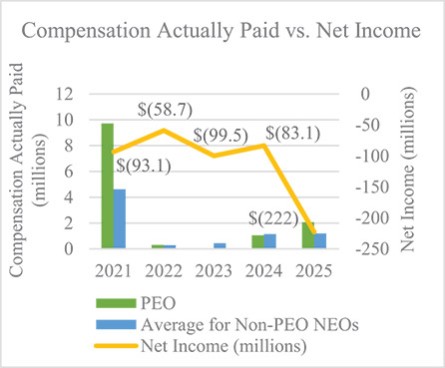
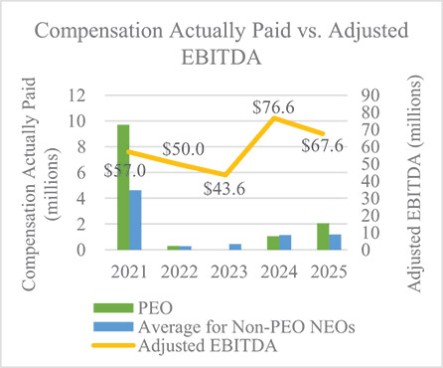
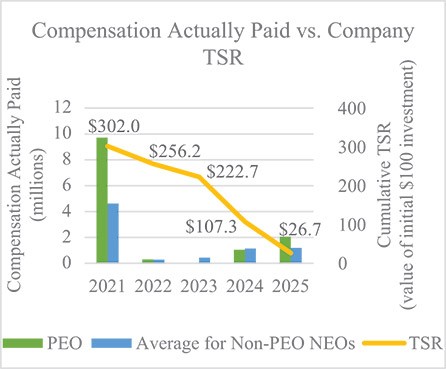
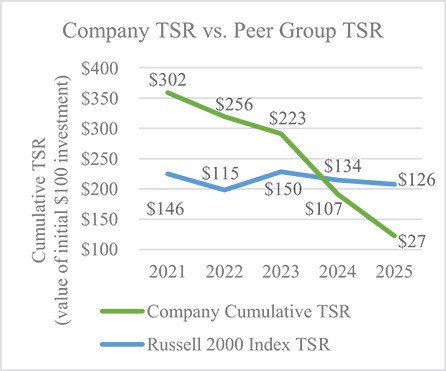
52
Risks Related to Compensation Policies and Practices
Our compensation committee regularly monitors and considers whether our overall compensation programs, including our executive compensation program, create incentives for employees to take excessive or unreasonable risks that could materially harm our Company. Although risk-taking is a necessary part of any business, our compensation committee focuses on aligning our Company’s compensation policies with the long-term interests of our Company and its stockholders and avoiding short-term rewards for management decisions that could pose long-term risks to our Company. Although a portion of our executive compensation plan is performance-based, which could motivate risk-taking, we do not believe our overall compensation structure encourages excessive or unnecessary risk-taking. We believe our approach to goal- setting, the mix of different types of compensation, payouts at multiple levels of performance, evaluation of performance results, and allowance for compensation committee discretion in determining award types, levels and payouts assist in mitigating these risks, as follows:
| ● | Our compensation structure includes a combination of compensation vehicles, including a competitive base salary and benefits generally available to all of our employees, equity awards to incentivize long-term performance and align the interests of our employees with those of our stockholders, annual cash incentives to reward executives for achieving Company objectives, and change in control and post-termination severance compensation to encourage retention of our key executives. |
| ● | To discourage excessive or unnecessary risk-taking, for 2025, payouts to each named executive officer under our performance-based cash incentive plan were based on seven distinct performance metrics, each with material weighting. Additionally, our compensation committee retains the discretion to increase or decrease payouts under this incentive plan as it deems appropriate. |
| ● | To help mitigate risks of overpayment, we maintain a clawback policy that complies with recently adopted SEC and Nasdaq requirements. We also have adopted stock ownership guidelines applicable to all of our named executive officers to ensure they have a meaningful equity stake in our Company. |
| ● | We further believe that our internal legal and financial controls appropriately mitigate the probability and potential impact of an individual employee committing our Company to a harmful long-term business transaction in exchange for a short-term compensation benefit. |
Based on the factors described above, we believe our 2025 compensation programs do not create risks that are reasonably likely to have a material adverse effect on our Company.
53
Calculation of 2025 Adjusted EBITDA
The following table shows adjusted EBITDA as we defined it for 2025 and reconciles this non-GAAP financial measure to the GAAP measure net income (loss):
| | | |
| | Year Ended | |
| | December 31, 2025 | |
| | (in thousands) | |
Net loss attributable to Clean Energy Fuels Corp. | | $ | (222,024) |
Income tax expense (benefit) | |
| (2,820) |
Loss on extinguishment of debt | |
| — |
Interest expense | |
| 52,687 |
Interest income | |
| (11,383) |
Depreciation and amortization | |
| 41,316 |
Accelerated depreciation expense associated with station equipment removal | |
| 56,041 |
Impairment of investments in equity securities | |
| — |
Impairment of goodwill | |
| 64,328 |
Gain on extinguishment of loan receivable and equity security | |
| (2,058) |
Amazon warrant charges | |
| 66,101 |
Stock-based compensation expense | | | 8,869 |
Loss from Rimere equity method investment | | | 5,446 |
Loss (gain) from SAFE S.p.A. equity method investment | | | 179 |
Loss (gain) from change in fair value of derivative instruments | | | 1,664 |
Depreciation and amortization from RNG upstream | |
| 12,113 |
Interest expense from RNG upstream | |
| 881 |
Interest income from RNG upstream | | $ | (1,904) |
Amortization of investment tax credit from RNG upstream | |
| (1,830) |
Adjusted EBITDA | | $ | 67,606 |
54
DIRECTOR COMPENSATION
Overview
We use cash and equity compensation to attract and retain qualified candidates to serve on our Board. The amount and type of cash and equity compensation awarded to non-employee directors in 2025 was determined by our compensation committee in its sole discretion. In setting non-employee director compensation for 2025, our compensation committee considered a variety of factors, including the significant amount of time that our directors spend in fulfilling their duties to our Company, as well as the level of experience and skill required of the members of our Board. Further, in setting director compensation, our compensation committee considered that a director’s independence may be jeopardized if director compensation and perquisites exceed customary levels, if our Company makes charitable or political contributions to organizations with which a director is affiliated or if our Company enters into consulting contracts with (or provides other indirect forms of compensation to) a director or an organization with which a director is affiliated. Directors who are our employees receive no additional compensation for their services as directors. In addition, each of Mr. Soulas, Ms. Boissy-Rousseau, Mr. Ramadier, and Mr. Lataillade voluntarily waived their right to receive compensation for their services as a director of our Company.
After reviewing the factors described above and others that it considered relevant, our compensation committee approved the non-employee director compensation program described below (the “Directors’ Compensation Policy”). The compensation paid pursuant to the non-employee director compensation program is described below.
Cash
For 2025, our non-employee directors (other than Messrs. Soulas, Ramadier, Lataillade, and Ms. Boissy-Rousseau) received the following cash compensation:
| | | |
Type of Retainer or Fee | | 2025 Amounts | |
Annual Cash Retainer | | $ | 70,000 |
Annual Chair Retainer | | $ | 60,000 |
Annual Audit Committee Chair Retainer | | $ | 15,000 |
Annual Compensation Committee Chair Retainer | | $ | 10,000 |
Annual Nominating and Corporate Governance Committee Chair Retainer | | $ | 5,000 |
Annual Audit Committee Member Retainer | | $ | 5,000 |
Annual Compensation Committee Member Retainer | | $ | 4,000 |
Annual Nominating and Corporate Governance Committee Member Retainer | | $ | 3,000 |
These cash retainers will be paid on a quarterly basis, following the end of each quarter in arrears, and will be pro-rated if a non-employee director serves (or serves in the corresponding position, as the case may be) for only a portion of the quarter.
Equity
Pursuant to the Directors’ Compensation Policy in effect during 2025, that initially went into effect on January 1, 2023, the non-employee directors receive an annual equity award with a value of $120,000, which award shall be fifty percent (50%) in non-statutory stock options (the “Annual Stock Option Award”) and fifty percent (50%) in restricted stock units of our Company (collectively with the Annual Stock Option Award, the “Equity Awards”). Equity Awards are generally granted to Directors on the date of each annual meeting. Subject to the non-employee director’s continued service with our Company, each Equity Award will vest in one installment on the first anniversary of the date of grant (or on the date prior to the following year’s annual meeting, if earlier). Each new non-employee director appointed or elected after the date of the Annual Meeting, will automatically be granted pro-rated amounts of the annual Equity Awards described above. In addition, each Equity Award will be subject to the terms and conditions of the Company’s equity plan and will be evidenced by, and subject to the terms and conditions of, any award agreement in the form approved by our Board to evidence such type of grant pursuant to the Directors’ Compensation Policy.
55
Each of our non-employee directors is also reimbursed for reasonable out-of-pocket expenses for attendance at Board and committee meetings.
Director Stock Ownership Guidelines
We believe it is important to encourage our directors to hold a material amount of our common stock, which links their long-term economic interest directly to that of our stockholders. To achieve this goal, we have established stock ownership guidelines applicable to our independent directors. These guidelines provide that each independent director is required to own shares of our common stock valued at $180,000 or more by five years after the date of a director’s initial election to our Board. Stock options are not counted toward satisfaction of these stock ownership requirements. Directors who attain this stock ownership level by the stated deadline will continue to satisfy the stock ownership requirements if the value of their stock holdings declines after such deadline solely due to a decrease in the trading price of our common stock. All of our independent directors are in compliance with these stock ownership guidelines as of the Record Date. See the descriptions under “Proposal 1: Election of Directors — General” and “Director Compensation” for more information.
We have also established stock ownership guidelines applicable to certain of our executive officers, which are described under “Compensation Disclosure and Analysis — Executive Stock Ownership Guidelines” above.
Director Compensation Table
The following summarizes the compensation we paid to directors who were not employees of our Company for 2025:
| | | | | | | | |
| | Fees Earned or | | Stock | | Option | | |
| | Paid in Cash | | Awards(2) | | Awards(3) | | Total |
Name(1) | | ($) | | ($) | | ($) | | ($) |
Stephen A. Scully(4) |
| 135,000 |
| 60,000 |
| 60,000 |
| 255,000 |
Lizabeth A. Ardisana(5) |
| 83,000 |
| 60,000 |
| 60,000 |
| 203,000 |
Karine Boissy-Rousseau | | — | | — | | — | | — |
Marc de Guilhem de Lataillade | | — | | — | | — | | — |
James C. Miller III(6) |
| 42,500 |
| — |
| — |
| 42,500 |
Kenneth M. Socha(7) |
| 38,500 |
| — |
| — |
| 38,500 |
Aimeric Ramadier | | — | | — | | — | | — |
Patrick J. Ford(8) |
| 80,000 |
| 60,000 |
| 60,000 |
| 200,000 |
Mathieu Soulas | | — | | — | | — | | — |
Vincent C. Taormina(9) |
| 84,000 |
| 60,000 |
| 60,000 |
| 204,000 |
| (1) | Andrew J. Littlefair, our President and Chief Executive Officer, is not included in this table because he is an employee of our Company and thus receives no additional compensation for his services as a director. The compensation received by Mr. Littlefair as an employee of our Company is shown in the Summary Compensation Table above. Messrs. Soulas, Ramadier, Lataillade, and Ms. Boissy-Rousseau each voluntarily waived their right to receive compensation for 2025. |
| (2) | On May 22, 2025, each non-employee director (other than Messrs. Miller, Socha, Soulas, Ramadier, Lataillade, and Ms. Boissy-Rousseau) received a restricted stock unit award covering 32,258 shares of common stock (the “2025 Director RSU Grants”). The amounts shown in this column represent the grant date fair value of the 2025 Director RSU Grants calculated in accordance with FASB ASC 718. The fair value of the RSU Grants was $1.86 reflecting the Company’s closing stock price on the grant date. |
| (3) | On May 22, 2025, each non-employee director (other than Messrs. Miller, Socha, Soulas, Ramadier, Lataillade, and Ms. Boissy-Rousseau) received an option award covering 45,112 shares and having an exercise price equal to $1.86 (the “2025 Director Option Grants”). The amounts shown in this column represent the grant date fair value of these option awards calculated in accordance with FASB ASC 718. For a discussion about the valuation models and assumptions used to calculate the fair value of these awards, see Note 12 to the consolidated financial statements included in the Annual Report. |
| (4) | As of December 31, 2025, Mr. Scully had fully vested and outstanding options to purchase the following: 40,000 shares at an exercise price of $1.37; 42,500 shares at an exercise price of $2.19; 42,000 shares at an exercise price of $2.56; 75,000 shares at an exercise price of $10.18; 86,956 shares at an exercise price of $6.60; 19,169 shares at an exercise price of $4.57; 32,608 shares at an exercise price of $2.62; and 45,112 outstanding unvested options to purchase shares at an exercise price of $1.86. As of December 31, 2025, Mr. Scully also had 32,258 outstanding unvested restricted stock units. |
56
| (5) | As of December 31, 2025, Ms. Ardisana had fully vested and outstanding options to purchase the following: 22,000 shares at an exercise price of $2.56; 51,813 shares at an exercise price of $10.18; 86,956 shares at an exercise price of $6.60; 19,169 shares at an exercise price of $4.57; 32,608 shares at an exercise price of $2.62; and 45,112 outstanding unvested options to purchase shares at an exercise price of $1.86. As of December 31, 2025, Ms. Ardisana also had 32,258 outstanding unvested restricted stock units. |
| (6) | Mr. Miller was not nominated for re-election at the 2025 Annual Meeting, and fees paid in cash represent payments made through to that date. |
| (7) | Mr. Socha was not nominated for re-election at the 2025 Annual Meeting, and fees paid in cash represent payments made through to that date |
| (8) | As of December 31, 2025, Mr. Ford had fully vested and outstanding options to purchase the following: 5,434 shares at an exercise price of $2.63; 32,608 shares at an exercise price of $2.62; and 45,112 outstanding unvested options to purchase shares at an exercise price of $1.86. As of December 31, 2025, Mr. Ford also had 32,258 outstanding unvested restricted stock units. Mr. Ford was appointed to our Board in March 2024. |
| (9) | As of December 31, 2025, Mr. Taormina had fully vested and outstanding options to purchase the following: 40,000 shares at an exercise price of $1.37; 42,500 shares at an exercise price of $2.19; 42,000 shares at an exercise price of $2.56; 51,813 shares at an exercise price of $10.18; 86,956 shares at an exercise price of $6.60; 19,169 shares at an exercise price of $4.57; 32,608 shares at an exercise price of $2.62; and 45,112 outstanding unvested options to purchase shares at an exercise price of $1.86. As of December 31, 2025, Mr. Taormina also had 32,258 outstanding unvested restricted stock units. |
57
EQUITY COMPENSATION PLANS
Securities Authorized for Issuance Under Equity Compensation Plans
The following table summarizes information about compensation plans under which our equity securities are authorized for issuance as of December 31, 2025:
| | | | | | | | |
| | Equity Compensation Plan Information | | |||||
| | Number of Securities | | Weighted-Average | | Number of Securities | | |
| | to be Issued upon | | Exercise Price of | | Remaining Available | | |
| | Exercise of | | Outstanding | | for Future Issuance | | |
| | Outstanding Options, | | Options, Warrants | | under Equity | | |
Plan Category | | Warrants and Rights | | and Rights | | Compensation Plans | | |
Equity compensation plans approved by security holders |
| 23,040,270 | (1) | $ | 5.44 | (2) | 14,161,668 | (3) |
Equity compensation plans not approved by security holders |
| — | |
| — | | — |
|
Total |
| 23,040,270 | | $ | 5.44 | | 14,161,668 |
|
| (1) | Of these shares, 99,850 were subject to options then outstanding under the 2006 Plan, 18,300,746 were subject to options then outstanding under the 2016 Plan, 1,096,920 were subject to RSUs then outstanding under the 2016 Plan, 376,096 were subject to options then outstanding under the 2024 Performance Incentive Plan and 3,166,658 were subject to RSUs then outstanding under the 2024 Performance Incentive Plan. Our Company’s authority to grant new awards under the 2006 Plan terminated upon the adoption of the 2016 Plan in May 2016. Our Company’s authority to grant new awards under the 2016 Plan terminated upon the adoption of the 2024 Performance Incentive Plan in May 2024. The 2024 plan was amended in May 2025. |
| (2) | This weighted-average exercise price does not reflect 4,263,578 shares that will be issued upon the settlement of outstanding RSUs. |
| (3) | Represents (a) 12,294,779 shares available for future issuance under the 2024 Plan as of December 31, 2025, and (b) 2,060,802 shares available for future issuance under the ESPP, excluding 193,913 shares that were subject to purchase under the ESPP during the purchase period ended December 31, 2025. Shares available under the Amended and Restated 2024 Performance Incentive Plan may be used for any type of award authorized in that plan. |
58
CERTAIN RELATIONSHIPS AND RELATED PARTY TRANSACTIONS
Related Party Transactions
Except as described below, since January 1, 2025, there has not been, nor is there currently proposed, any transaction or series of similar transactions in which we were or are to be a participant, in which the amount involved exceeds $120,000 and in which any of our directors, executive officers, holders of more than 5% of our common stock or any immediate family member of any of the foregoing had or will have a direct or indirect material interest. This does not include employment compensation or compensation for Board service, which are described elsewhere in this Proxy Statement.
Relationships with TotalEnergies and its Affiliates
During 2025, we recognized no revenue related to RINs and LNG sold to TotalEnergies and its affiliates in the ordinary course of business and alternative fuel tax credits (“AFTCs”) associated therewith.
During 2025, we paid TotalEnergies $0.9 million for expenses incurred in the ordinary course of business and settlements on commodity swap contracts.
TotalEnergies Agreements
On May 9, 2018, we entered into a stock purchase agreement (the “Purchase Agreement”) with TMS for the sale and issuance to TMS of up to 50,856,296 shares of our common stock, representing approximately 25% of the then outstanding shares of our common stock and the largest ownership position of our Company, for a per share purchase price of $1.64 and an aggregate cash purchase price of $83.4 million. The private placement with TotalEnergies closed on June 13, 2018.
Pursuant to the Purchase Agreement, TMS has the right to designate up to two individuals to serve as directors on our Board. Subject to certain limited conditions as described in the Purchase Agreement, including compliance with our governing documents and all applicable laws, rules and regulations, we will be obligated to appoint or nominate for election as directors of our Company the individuals so designated by TMS and, from and after such appointment or election, either (1) appoint one of these individuals to serve on our audit committee and any other Board committees that may be formed from time to time for the purpose of making decisions that are strategically significant to our Company, or (2) nominate another individual as an observer of such Board committees, who is to be invited to attend all meetings of such committees in a non-voting observer capacity. TMS’ rights and our obligations relating to these designees and observers continue until (and if) (a) with respect to TMS’ right to designate two individuals to serve as directors on our Board and an optional observer to serve on certain Board committees, TMS’ voting power is less than 16.7% but more than 10.0%, and (b) with respect to TMS’ right to designate one individual to serve as a director on our Board and an optional observer to serve on certain Board committees, TMS’ voting power is less than 10.0%, in each case measured in relation to the votes then entitled to be cast in an election of directors by our stockholders.
The Purchase Agreement also provides that, until such date when TMS ceases to hold more than 5% of our common stock then outstanding, among other similar undertakings and subject to customary conditions and exceptions, TMS and its affiliates are prohibited from purchasing shares of our common stock or otherwise pursuing transactions that would result in TMS owning more than 30% of our equity securities without the approval of our Board.
In connection with the Purchase Agreement on May 9, 2018, we and all of our then-directors and officers entered into a voting agreement with TMS. Pursuant to the voting agreement, each of our directors and officers agreed to vote all shares of our common stock presently or hereafter owned or controlled by such director or officer, in any vote of our stockholders that may be held from time to time, in favor of the election of the individuals designated by TMS to serve as directors on our Board. Each of our directors and officers has also granted to TMS a proxy to vote all such shares in accordance with the terms of the voting agreement. For each of our directors and officers party to the voting agreement, the voting obligations contained in the agreement continue from and after, and for so long as, TMS’ director designation rights are in effect, as described above, and such director or officer continues to serve in such capacity for our Company and continues to hold shares of our common stock.
59
Pursuant to the Purchase Agreement, we also entered into a registration rights agreement with TMS on June 13, 2018. Pursuant to the registration rights agreement, we became obligated to, at our expense, (1) file one or more registration statements with the SEC to cover the resale of the shares of our common stock purchased by TMS under the Purchase Agreement, (2) use our commercially reasonable efforts to cause all such registration statements to be declared effective in a timely manner, (3) use our commercially reasonable efforts to maintain the effectiveness of such registration statements until all such shares are sold or may be sold without restriction pursuant to applicable rules under the Securities Act, and (4) make and keep available adequate current public information and timely file with the SEC all required reports and other documents until all such shares are sold or may be sold without restriction. If such registration statements are not filed or declared effective as described above or any such effective registration statements subsequently become unavailable for more than 30 days in any 12-month period while they are required to be maintained as effective, then we would be required to pay liquidated damages to TMS equal to 0.75% of the aggregate purchase price for the shares remaining eligible for such registration rights each month for each such failure (up to a maximum of 4.0% of the aggregate purchase price for the shares remaining eligible for such registration rights each year).
Commodity Swap Arrangements
In October 2018, we entered into commodity swap arrangements with TotalEnergies Gas & Power North America, an affiliate of TotalEnergies and TotalEnergies Holdings USA Inc. (“THUSA”), intended to manage diesel price fluctuation risks related to the natural gas fuel supply commitments we expect to make in our anticipated fueling agreements with fleet operators that participate in our Zero Now truck financing program, which arrangements cover five million diesel gallons of natural gas fuel volume annually from April 2019 through June 2024. During the year ended December 31, 2025, our Company paid TotalEnergies Gas & Power North America $0.9 million for expenses incurred in the ordinary course of business, settlements on commodity swap contracts and recognized revenue of $0.0 million related to settlements on commodity swap contracts.
Joint Venture
On March 3, 2021, we entered into an agreement (the “TotalEnergies JV Agreement”) with TotalEnergies to create 50-50 joint ventures to develop ADG RNG production facilities in the United States. The TotalEnergies JV Agreement contemplates investing up to $400.0 million of equity in production projects, and TotalEnergies and our Company each committed to initially provide $50.0 million. Pursuant to the TotalEnergies JV Agreement, our Company and TotalEnergies have given each party a limited right of first opportunity to invest in ADG RNG projects they respectively originate. Currently, there is one ADG RNG joint venture project in operation pursuant to the TotalEnergies JV Agreement. This project is estimated to produce up to 0.8 million GGEs of RNG annually, all of which is available to the Company for sale to the vehicle fuels market. During 2025, we recognized management fee revenue of $3.5 million related to the joint venture with TotalEnergies.
Relationship Involving Mr. Littlefair
On April 22, 2026 the Company entered into a Transition, Consulting and Release Agreement (the “Consulting Agreement”) with Andrew J. Littlefair, our former President and Chief Executive Officer and current director of our Board. The consulting agreement has a three-year term (the “Consulting Term”), and engages Mr. Littlefair to provide strategic advisory and government-relations services to the Company under the direction of the Board. Under the consulting agreement, Mr. Littlefair will be entitled to a base consulting retainer at an annual rate of $750,000 and a grant of RSUs with an intended grant date value equal to $1,000,000, vesting in three substantially equal annual installments on each of the first three anniversaries of the start of the consulting term, subject to Mr. Littlefair’s continued provision of services under the consulting agreement.
Pursuant to the Consulting Agreement and in connection with Mr. Littlefair no longer being a full-time employee of the Company, Mr. Littlefair will be entitled to: (i) all accrued but unpaid salary and vacation through April 22, 2026 and (ii) provided Mr. Littlefair executes and does not revoke a general release of claims against the Company and its affiliates, (a) any 2026 annual bonus Mr. Littlefair would have received had his employment as President and Chief Executive Officer continued through the end of the year, provided that such bonus does not exceed 150% of his 2025 base salary, (b) a monthly stipend intended to cover benefits of $5,000 per month during the first eighteen months of the Consulting
60
Term (for an aggregate of $90,000), which the parties may choose to implement through COBRA premium reimbursement and (c) annual life insurance premiums for five years in the amount of $43,485 per year for a maximum of $217,425. Our audit committee has reviewed and approved this related party transaction and the continued related party relationship.
Drew Littlefair, son of Mr. Littlefair, is employed by HUB International Limited (“HUB”). HUB served as the Company’s insurance brokerage firm in the year ended December 31, 2025. In this capacity, as part of insurance placement, HUB and certain HUB executive employees on the Company’s account earn amounts from insurance carriers as part of insurance premiums paid by our Company for various lines of insurance coverage obtained through HUB’s services. During the year ended December 31, 2025, we paid approximately $17,490,230 in premiums for this insurance coverage. Drew Littlefair received approximately $305,331 in amounts related to our Company’s account with HUB. Our audit committee has reviewed and approved this related party transaction and the continued related party relationship.
Policies and Procedures for Related Party Transactions
Our audit committee charter requires that all related party transactions, as defined in applicable SEC rules, be reviewed and approved by our audit committee or another independent body of our Board, in accordance with applicable Nasdaq rules. When evaluating any such transaction, our audit committee focuses on whether the terms of the transaction are at least as favorable to us as terms we would receive on an arm’s-length basis from an unaffiliated third party. Each transaction described above that was required to be reviewed and approved by our audit committee in accordance with its charter was so reviewed and approved.
OTHER MATTERS
Stockholder Proposals for 2027 Annual Meeting
Stockholder Proposals to be Considered for Inclusion in Our Proxy Materials
Stockholder proposals submitted pursuant to Rule 14a-8 under the Exchange Act and intended to be presented at our 2027 annual meeting of stockholders and considered for inclusion in our proxy materials for that meeting must be received by our Corporate Secretary at our principal executive offices no later than December 31, 2026. However, if we change the date of the 2027 annual meeting of stockholders by more than 30 days from the date of this year’s Annual Meeting, then such proposals must be received a reasonable time before we begin to print and send our proxy materials for the 2027 annual meeting of stockholders.
Director Nominations or Stockholder Proposals to be Brought Before an Annual Meeting But Not Included in Our Proxy Materials
Our amended and restated bylaws provide that, for stockholder nominations of directors or other proposals to be considered at an annual meeting but not sought to be included in our proxy materials for the meeting, the stockholder must have given timely written notice of the director nomination or proposal to us. To be timely for our 2027 annual meeting of stockholders, a stockholder’s notice must be delivered to or mailed and received by our Corporate Secretary at our principal executive offices between the close of business on March 12, 2027 and the close of business on April 11, 2027; provided, however, that if no annual meeting was held in the previous year or our 2027 annual meeting of stockholders is not held between May 11, 2027 and June 10, 2027, then notice will be timely if it is received not earlier than the close of business on the 90th day prior to such annual meeting and not later than the close of business on the later of the 60th day prior to such annual meeting or, in the event public announcement of the date of such annual meeting is first made by us fewer than 70 days prior to the date of such annual meeting, the close of business on the 10th day following the day on which public announcement of the date of such meeting is first made by us. A stockholder’s notice to our Company must set forth, as to each director nominee or other proposal the stockholder proposes to bring before our 2027 annual meeting, all of the information required by our amended and restated bylaws. We will not entertain any director nominations or other proposals at the Annual Meeting or at our 2027 annual meeting that do not meet the requirements set forth in our amended and restated bylaws. Stockholder proposals or director nominations submitted to our Corporate Secretary that do not comply with the above requirements may not be brought before the 2027 annual meeting of stockholders.
61
In addition, a stockholder who intends to solicit proxies in support of director nominees other than our Company’s nominees at the 2027 annual meeting of stockholders must provide written notice to our Company setting forth the information required by Rule 14a-19 under the Exchange Act, unless the required information has been provided in a preliminary or definitive proxy statement previously filed by the stockholder. Such written notice must be provided in accordance with Rule 14a-19 no later than April 11, 2027. If we change the date of the 2027 annual meeting of stockholders by more than 30 days from the date of this year’s Annual Meeting, written notice must be provided by the later of 60 days prior to the date of the 2027 annual meeting of stockholders or the 10th day following the day on which public announcement of the date of the 2027 annual meeting of stockholders is first made. The notice requirement under Rule 14a-19 is in addition to the applicable notice requirements under our amended and restated bylaws as described above.
Stockholder Proposal not Included Pursuant to Rule 14a-8(i)(7)
We are providing this information to ensure that we are communicating proactively and maintaining transparency with our stockholders, about our determination to exclude a stockholder proposal in this Proxy Statement pursuant to Rule 14a-8(i)(7) as a matter relating to the ordinary business operations our Company and therefore contrary to the SEC Staff’s proxy rules.
On November 17, 2025, the SEC changed its longstanding practice, and issued a statement that it will not express views on the reasons companies intend to exclude proposals cited in no-action letter requests, and will not object if companies omit proposals if the company represents to the SEC that has a reasonable basis to exclude the shareholder proposal based on Rule 14a-8 (the “SEC Statement”).
On December 8, 2025, we received consecutive letters from Gerald J. Kanonczyk (the “Proponent”) containing a proposal and supporting statement for inclusion in our Proxy Statement, resolving that our Company shall engage an independent financial advisor to conduct a comprehensive strategic review of our Company. Following correspondence with the Proponent, we asked the Proponent to withdraw the stockholder proposal, noting the basis for exclusion under Rule 14a-8(i)(7), and the Proponent declined. On January 16, 2026, pursuant to the SEC Statement, we submitted correspondence to the SEC representing without qualification that we have a reasonable basis to exclude the stockholder proposal based on Rule 14a-8(i)(7). On January 30, 2026, the SEC responded that based solely on that representation, the SEC will not object if we exclude the stockholder proposal from this Proxy Statement. Our notice to the SEC explaining in greater detail the bases for our exclusion of this proposal is available on the SEC’s website (https://www.sec.gov/files/corpfin/no-action/14a-8/kanonczykcleanenergyfuelcorp13026.pdf).
Other Business at the Annual Meeting
We have not received any notice of other business to come before the Annual Meeting as of the date of this Proxy Statement and we do not otherwise know of any other business to be submitted at the Annual Meeting. If any other matters are properly brought before the Annual Meeting, the individuals we have designated as proxies for the Annual Meeting will vote on such matters in their discretion. It is the intention of such individuals to vote the shares represented by proxy at the Annual Meeting on any such matter as recommended by our Board or, if no recommendation is given, in accordance with their judgment.
62
More Information About our Company
For more information about our Company, please refer to our Annual Report, which accompanies this Proxy Statement. Our annual report on Form 10-K for the year ended December 31, 2025, which is a part of the Annual Report, was filed with the SEC on February 24, 2026 and is accessible on our website at https://investors.cleanenergyfuels.com/company-information/annual-reports. You may also obtain a copy of the Annual Report at no charge and copies of any exhibit listed in the Annual Report for a fee (equal to our reasonable expenses in furnishing such exhibit) by sending a written request to the attention of Investor Relations at the address of our principal executive offices.
| |
| By order of the Board, |
| |
|
|
| |
| JAMES W. SYTSMA |
| Corporate Secretary |
63

Signature [PLEASE SIGN WITHIN BOX] Date Signature (Joint Owners) Date TO VOTE, MARK BLOCKS BELOW IN BLUE OR BLACK INK AS FOLLOWS: KEEP THIS PORTION FOR YOUR RECORDS DETACH AND RETURN THIS PORTION ONLY THIS PROXY CARD IS VALID ONLY WHEN SIGNED AND DATED. V96649-P40523 ! ! ! 01) Barclay F. Corbus 02) Stephen A. Scully 03) Lizabeth A. Ardisana 04) Patrick J. Ford 05) Andrew J. Littlefair 06) Vincent C. Taormina For All Withhold All For All Except For Against Abstain ! ! ! ! ! ! To withhold authority to vote for any individual nominee(s), mark "For All Except" and write the number(s) of the nominee(s) on the line below. 3. To approve, on an advisory, non-binding basis, the compensation of our named executive officers. The Board of Directors recommends you vote FOR proposals 2 and 3. 2. To ratify the appointment of KPMG LLP as our independent registered public accounting firm for our fiscal year ending December 31, 2026. NOTE: Such other business as may properly come before the meeting or any adjournment or postponement thereof. CLEAN ENERGY FUELS CORP. 1. To elect six directors to the Board of Directors Nominees: The Board of Directors recommends you vote FOR ALL the director nominees: Authorized Signatures. This section must be completed for your vote to be counted. Date and Sign Below. Please sign exactly as name(s) appear(s) hereon. Joint owners should each sign. When signing as attorney, executor, administrator, corporate officer, trustee, guardian, or custodian, please give full title. SCAN TO VIEW MATERIALS & VOTEw CLEAN ENERGY FUELS CORP. 4675 MACARTHUR COURT, SUITE 800 NEWPORT BEACH, CA 92660 VOTE BY INTERNET Before The Meeting - Go to www.proxyvote.com or scan the QR Barcode above Use the Internet to transmit your voting instructions and for electronic delivery of information. Vote by 11:59 P.M. ET on June 9, 2026. Have your proxy card in hand when you access the web site and follow the instructions to obtain your records and to create an electronic voting instruction form. During The Meeting - Go to www.virtualshareholdermeeting.com/CLNE2026 You may attend the meeting via the Internet and vote during the meeting. Have the information that is printed in the box marked by the arrow available and follow the instructions. VOTE BY PHONE - 1-800-690-6903 Use any touch-tone telephone to transmit your voting instructions. Vote by 11:59 P.M. ET on June 9, 2026. Have your proxy card in hand when you call and then follow the instructions. VOTE BY MAIL Mark, sign and date your proxy card and return it in the postage-paid envelope we have provided or return it to Vote Processing, c/o Broadridge, 51 Mercedes Way, Edgewood, NY 11717.
V96650-P40523 Important Notice Regarding the Availability of Proxy Materials for the Annual Meeting: The Annual Report and Notice and Proxy Statement are available at www.proxyvote.com THIS PROXY IS SOLICITED ON BEHALF OF THE BOARD OF DIRECTORS OF CLEAN ENERGY FUELS CORP. I hereby appoint Stephen A. Scully and Barclay F. Corbus, or either of them, as proxies, with power of substitution to each, to vote all shares of common stock that I am entitled to vote at the Annual Meeting of Stockholders of Clean Energy Fuels Corp. to be held on Wednesday, June 10, 2026 at 9:00 am PDT, or at any adjournment or postponement thereof, in accordance with the instructions on the reverse side of this card and with the same effect as though I were present in person and voting such shares. My appointed proxies are authorized in their discretion to vote upon such other business as may properly come before the Annual Meeting or any adjournment or postponement thereof. UNLESS A CONTRARY DIRECTION IS INDICATED, THIS PROXY WILL BE VOTED "FOR ALL" NOMINEES FOR DIRECTOR LISTED IN PROPOSAL 1 AND "FOR" PROPOSALS 2 AND 3, AND IN THE DISCRETION OF THE APPOINTED PROXIES UPON SUCH OTHER BUSINESS AS MAY PROPERLY COME BEFORE THE ANNUAL MEETING. IF SPECIFIC INSTRUCTIONS ARE INDICATED, THIS PROXY WILL BE VOTED IN ACCORDANCE THEREWITH. (CONTINUED, AND TO BE SIGNED AND DATED ON REVERSE SIDE)